AI Heading to Space: Orbital Computing and the Future of Space AI Data Centers
AI Heading to Space: Orbital Computing and the Future of Space AI Data Centers
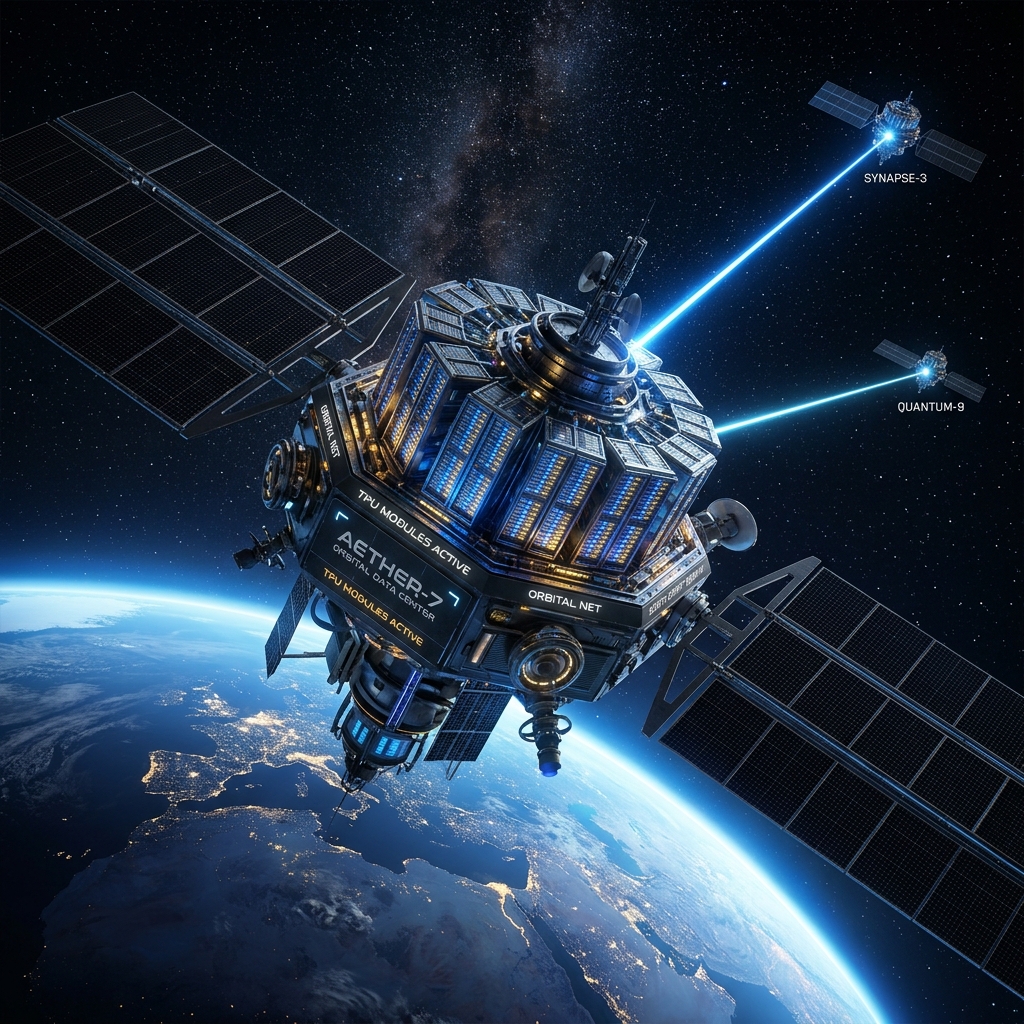
With the explosive growth of artificial intelligence (AI) in recent years, the massive power consumption and carbon footprint of Large Language Models (LLMs) and deep learning infrastructure have become critical global issues. Terrestrial data centers are hitting physical barriers such as power supply shortages and cooling system limits.
Under these circumstances, global tech giants and space startups are looking beyond Earth for new solutions. These are "Orbital Computing" and "Space AI Data Centers," which build artificial intelligence computing systems in outer space. Based on 2026 Google Trends and industry developments, let's explore in depth the innovations created by the fusion of AI and space technology, as well as the hidden technical challenges behind them.
1. What is Orbital Computing and Edge AI Satellites?
In the past, artificial satellites acted as simple collectors, gathering raw data (images, sensor values, etc.) in space and transmitting it back to ground stations. However, as the volume of data to be transmitted grew exponentially, the bandwidth limitations and transmission latency with ground stations became a major bottleneck.
Orbital Computing is an "Edge AI" technology that mounts high-performance AI chips directly onto satellites to analyze and process data immediately in space.
- Real-time Data Processing: Instead of waiting to send raw images to Earth, AI analyzes and detects anomalies, such as wildfires, floods, or defense threats, directly on the satellite camera.
- Bandwidth Reduction: By discarding useless noise data and compressing only the core "insights" to send to Earth, it dramatically saves satellite communication bandwidth.
A key communication backbone for this is Starlink's Laser Communication (Laser Mesh Network). Through optical inter-satellite links, a space backbone network is being established that allows terabytes of data to be transmitted at high speed in Low Earth Orbit (LEO) without relying constantly on ground stations.
2. Global Tech Giants Compete for Space AI: Google and SpaceX
In 2026, the space computing market has transitioned from a mere concept into a concrete execution phase.
Google's "Project Suncatcher"
Google is running an ambitious moonshot initiative called "Project Suncatcher" to build space AI infrastructure.
- Onboard Space TPUs: It equips solar-powered satellites with Google's custom AI accelerators, TPUs (Tensor Processing Units), to perform machine learning model training and inference directly in space.
- Launch Partnerships: Google is actively negotiating launch partnerships with SpaceX and other rocket launch providers to deploy these AI satellites into Low Earth Orbit.
SpaceX and Starcloud Partnership
SpaceX CEO Elon Musk has also publicly positioned orbital data centers as a future necessity to bypass terrestrial power constraints, mapping out a roadmap that integrates xAI's models with SpaceX's orbital infrastructure.
- Optical Network Integration: In May 2026, orbital computing startup 'Starcloud' signed a contract with SpaceX's Starlink division to integrate 'Mini Laser' terminals. Starcloud's orbital data centers will utilize Starlink's inter-satellite laser mesh network as a backbone to provide ultra-low-latency computing services globally.
3. Three Technical Challenges for Space AI Data Centers
While building data centers in space is attractive, there are critical obstacles due to the extreme environments of outer space, which are entirely different from Earth.
1) Heat Dissipation in a Vacuum
Terrestrial data centers dissipate heat by circulating air (air cooling) or water (liquid cooling). However, in the vacuum of space where there is no atmosphere, convection does not occur.
- Solution: Heat generated by the system must be dissipated purely through radiation. This requires massive radiative heat sinks, and since cooling efficiency is much lower than on Earth, low-power/high-efficiency chip designs are crucial.
2) Cosmic Radiation and Bit Flips
In Low Earth Orbit, without the full protection of Earth's magnetosphere, high-energy cosmic rays strike semiconductor chips directly.
- Solution: Radiation particles can randomly alter the state of memory semiconductors, causing Bit Flips or Single Event Upsets (SEUs), leading to computational errors or system crashes. To overcome this, engineers use physical radiation shielding or implement Triple Modular Redundancy (TMR), where three chips perform the same calculation simultaneously and verify results via a majority vote.
3) Economics and Supply Chain Limits
Even though launch costs have dropped significantly thanks to SpaceX's Starship, the cost of manufacturing space-grade semiconductor packaging and satellites remains extremely high compared to building terrestrial data centers. Furthermore, amid global shortages of high-end AI accelerators (GPUs/TPUs), securing chips validated for space-grade reliability is a major hurdle.
4. Key Takeaways for Readers
- Expanding Infrastructure Beyond Earth: Future AI data centers, restricted by power grids and environmental regulations on Earth, are highly likely to expand into outer space where solar energy is virtually unlimited.
- The Ultimate Form of Edge AI: The paradigm will shift from a "cloud-centric" architecture—where all data is sent to Earth for processing—to an "extreme edge" architecture, where data is refined directly at the source of production (orbital orbit).
- Opportunities in a New Hardware Ecosystem: New unicorn startups will emerge in the space computing hardware sector, specializing in radiation-hardened low-power AI chips, miniature laser communication equipment, and ultra-efficient radiative cooling systems.
The convergence of AI and space tech is no longer just sci-fi; it is a real business domain where tech giants are investing massive capital. It will be fascinating to watch how tens of thousands of AI brains operating in orbit above us will transform life on Earth.


Comments
Post a Comment