What I Learned from Integrating Multiple AI Assistants into Slack (First Impression Reviews on OpenClaw, Manus, Antigravity, and Codex)
What I Learned from Integrating Multiple AI Assistants into Slack
First Impression Reviews on OpenClaw, Manus, Antigravity, and Codex
Recently, I have been testing OpenClaw, Manus, Antigravity, and Codex by connecting each of them to Slack to see if they can function as practical work assistants.
Initially, I simply wanted to compare "which AI is smarter." However, after actually linking them to Slack, the key points of comparison turned out to be quite different. It wasn't just about model performance. In reality, the following four factors were far more critical:
First, how naturally do they converse within Slack? Second, how well do they integrate with external services or my local work environment? Third, are the token or credit costs sustainable? Fourth, do they operate stably without freezing or disconnecting?
To put it briefly, there is no single tool yet that can do it all. Each had distinct strengths and weaknesses, and it felt much more realistic to assign different roles and mix them together.
Manus: Great Conversational Experience, but Terrifying Costs
Manus provided the closest feeling to talking to a real human.
When I messaged it on Slack, it responded quite naturally, and the back-and-forth flow of sending short, rapid messages worked well. In fact, it sent so many fragmented messages that the Slack notifications became a bit annoying.
However, the major issue was cost.
Manus is not a PC-installed tool. Therefore, it faced clear limitations in directly manipulating files on my PC or performing local tasks. Although there seemed to be a way to connect it to the PC, I initially configured it to connect with GitHub so that the AIs could see each other's work.
The issue arose when giving instructions within Slack. Manus seemed to continuously scan Slack messages to find relevant information, consuming credits rapidly in the process. In one instance, it consumed over 1,000 credits for a single instruction, only to stop and say it "could not find relevant information on Slack."
At $20 for 4,000 credits, this means a single task execution—which might not even succeed—costs nearly $5.
This is too heavy a burden for daily, continuous operations as a work assistant. While the conversation flow is excellent, it is hard to use as a practical automation tool if costs are unpredictable.
For this reason, I decided to exclude Manus for now under current standards.
Codex: Strong Google Integration, Best Candidate for Main Assistant
Codex performed surprisingly well from a personal assistant perspective.
In particular, the Google MCP connection was seamless. By linking Calendar and Gmail, checking schedules or reading emails felt very natural. When I requested tasks like "check my schedule" or "check my emails" on Slack, it worked very close to a real assistant.
I had thought of Codex purely as a development tool, but connecting it with Google Workspace shifted its role much closer to a personal assistant.
However, there were some drawbacks.
When attempting to run it in Codex App form to connect with my local PC, I ran into macOS limitations. Since I do not use Mac as my main system, this was quite inconvenient. If it could be linked smoothly in a Windows environment, its utility would skyrocket, but right now, this limitation is a bottleneck.
Even so, Codex remains a strong candidate for the main assistant role just due to its seamless Google integration.
For now, Codex is the most practical choice for a "Slack-based work assistant."
OpenClaw: Not the Smartest, but Surprisingly Usable
To be frank, OpenClaw still doesn't feel exceptionally smart.
In terms of response quality, it falls behind Manus or Antigravity. Sometimes it ran into permission issues or consumed significant memory trying to load necessary modules, which made operations a bit clunky.
Yet, it is strangely difficult to discard completely.
OpenClaw is exceptionally good at finding and summarizing past conversations. In practice, this is highly important. When using a Slack AI assistant, retrieving and referencing past context often becomes more critical than just answering a single one-off question.
Of course, even if the model in use is gpt-5.3-codex, it is hard to say its efficiency is strictly better than Codex's Slack connection. Thus, I am considering pausing OpenClaw for now.
Still, the direction of OpenClaw is solid. Even if it's slightly less intelligent, if it can organize conversation history well and connect to a local environment, it could play a great role as a "personal workshop assistant."
Antigravity: Ideal for Code Modifications and Complex Workflows
Antigravity feels slightly smarter than OpenClaw.
It is particularly useful when modifying code or handling complex tasks. Rather than simple Q&A, it fits much better with multi-step tasks or scheduled workflows.
Therefore, Antigravity should be viewed more as a "task executor" rather than a "conversational assistant."
However, stability remains an issue.
During usage, it occasionally stopped responding, possibly due to polling errors. Currently, if there is no response, I simply restart it to process the task. It could be a configuration issue, but it still feels a bit unstable for long-term continuous integration.
Nevertheless, it is worth keeping for complex code modifications and workflow automation.
Getting AIs to Talk to Each Other is Harder Than Expected
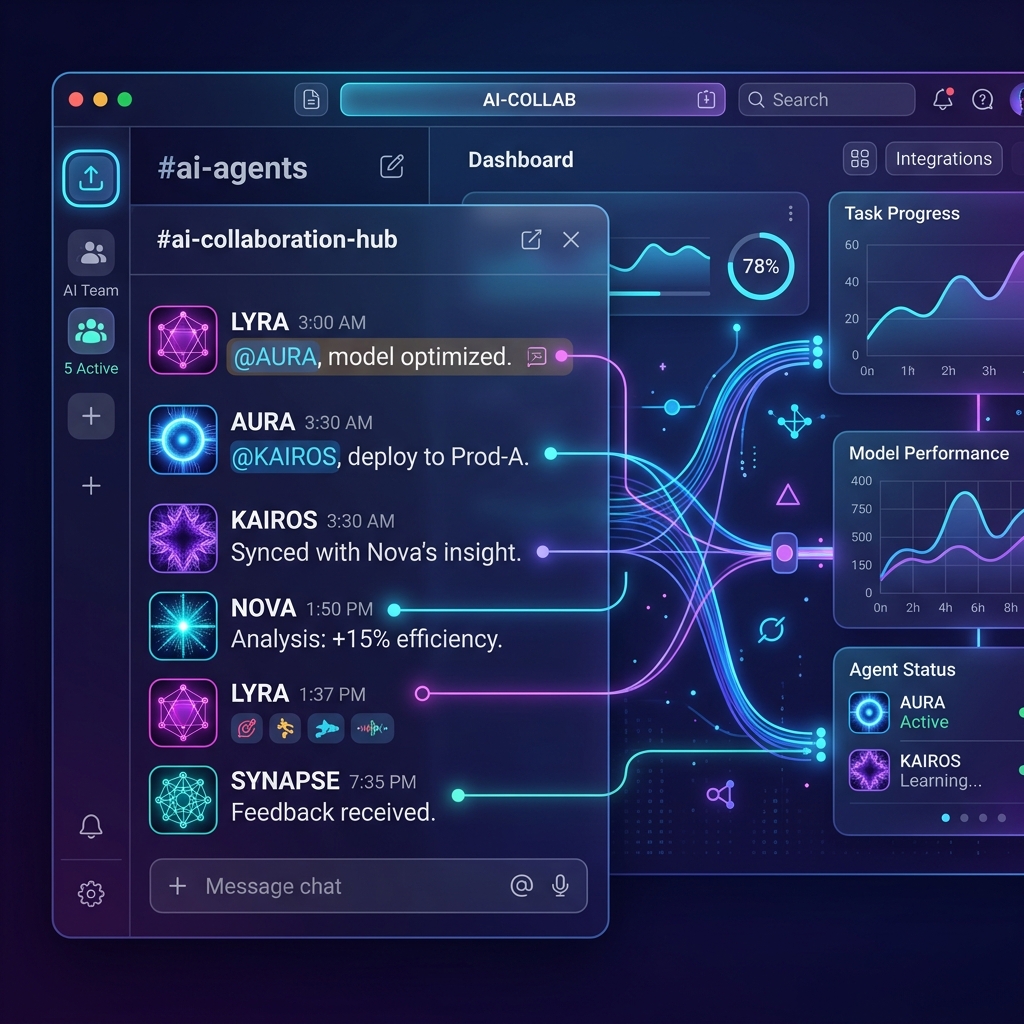
I also conducted a fun experiment: putting multiple AIs into a single Slack channel and having them talk to each other. I expected them to exchange opinions, with one performing the work and another reviewing the results.
But in reality, it was dead silent.
This is likely because each tool has different bot mention rules, channel message detection, event triggers, and permission settings. Simply placing them in the same channel does not trigger automated collaboration.
Ultimately, to enable multi-AI collaboration, the following structure seems necessary:
One main assistant to receive user instructions, One executor to modify code, One reviewer to inspect results, One recorder to summarize Slack or GitHub changes.
In other words, rather than just adding multiple AIs, role distribution and routing are what truly matter.
Current Role Distribution
Based on my initial experience, the roles are divided as follows:
Manus has great conversation flow but is too expensive to sustain. Excluded for now.
Codex integrates well with Google and is ideal for checking Calendar and Gmail. It is currently the closest candidate for the main assistant.
Antigravity is suited for code modification, complex tasks, and scheduled workflows. The freezing issue needs ongoing troubleshooting.
OpenClaw is less smart but excels at organizing conversation history. However, due to its low efficiency compared to Codex, I am considering pausing it temporarily.
Conclusion: We Need a Combination of Specialized AIs, Not a Single Giant AI
The takeaway from this test is clear.
Connecting AI assistants to Slack is fully possible. However, we are not yet at the stage where a single AI can handle every role perfectly.
One AI excels at natural conversation, Another has great Google integration, Another is strong at code modifications, And another excels at organizing past chat history.
The real challenge is how to mix and match them.
Going forward, the key question will not be "which AI is the best?" but rather "which role should we assign to which AI?"
Especially interesting is that you must directly construct and experience a multi-agent environment to clearly understand and select the agent that fits you best. When using just one AI, its response quality or small bugs feel like limitations of the AI itself, leaving you unsure of what to choose. However, when running multiple agents simultaneously and comparing them while assigning roles, each tool's unique traits and true strengths (Google integration, history recall, code generation, etc.) stand out clearly. Ultimately, to build your own optimized assistant team, going through a multi-agent setup is essential.
A realistic setup in my mind is:
Keep Codex as the main work assistant, Use Antigravity for code modifications and running complex workflows, Keep OpenClaw as a local work assistant or history organizer for further potential, Exclude Manus from daily operations until its cost model stabilizes.
The era of AI assistants has arrived. However, what we need right now is not a single, smarter AI.
What we need is the design of how to distribute multiple AIs within actual workflows, how to control costs, and how to operate them stably.
In the end, running AI assistants is very similar to running infrastructure. You cannot look at performance alone. You must consider costs, permissions, stability, disaster recovery, logging, and retry mechanisms.
The moment you attach an AI to Slack, it is no longer just a chatbot; it becomes an operating system.
Tip: How to Make Your Agent Smarter
If you want to make your agent smarter and more capable, I recommend having your agent learn from this repository, which integrates various open-source skills. Simply feed a single instruction to your agent:
Please integrate any features you need from the URL below. https://github.com/LowyShin/giip-dev-agent


Comments
Post a Comment