AI Heading to Space: The Convergence of AI and Space Tech Revealed by Google Trends
AI Heading to Space: The Convergence of AI and Space Tech Revealed by Google Trends
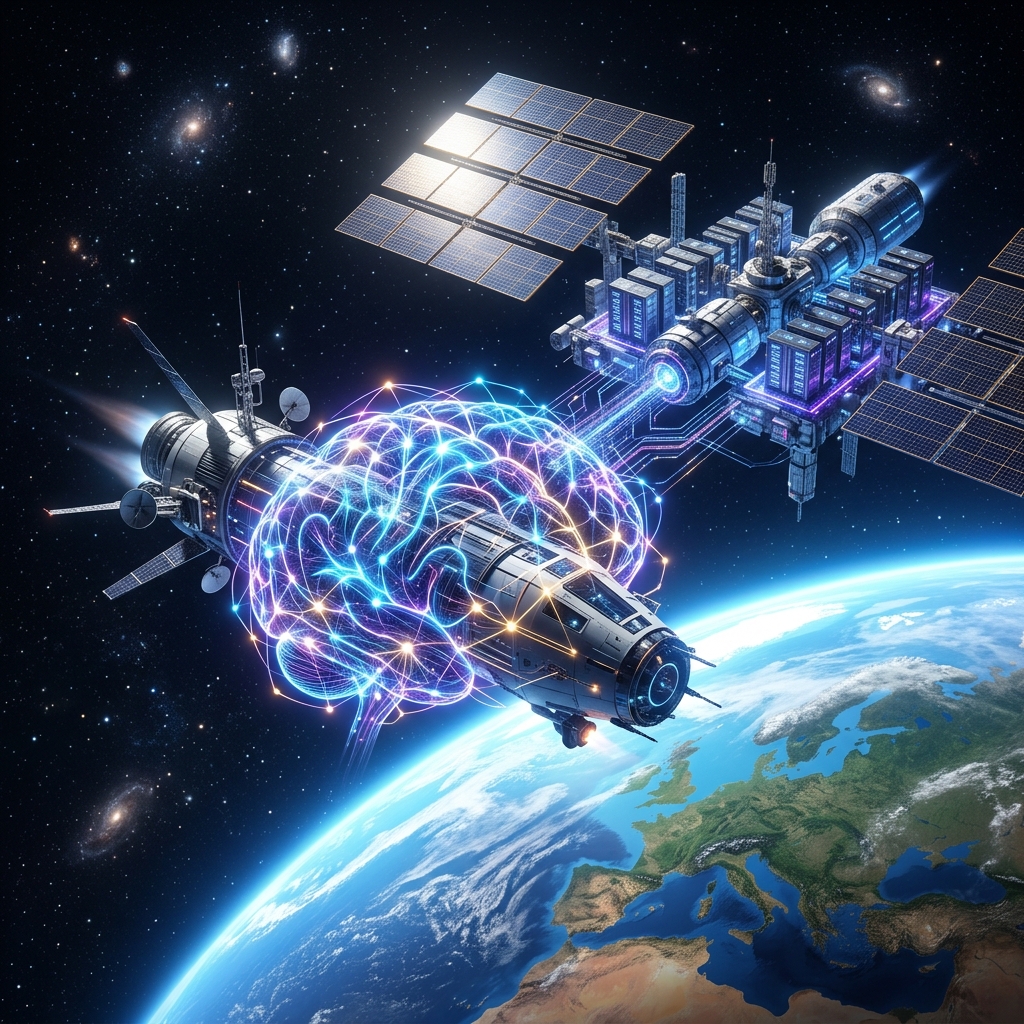
Analyzing recent search trends on Google Trends reveals a significant intersection capturing the attention of both the public and the global IT industry: the convergence of Artificial Intelligence (AI) and Space Technology (Space Tech). Especially in June 2026, the massive computing deal between Google and SpaceX, alongside the upcoming SpaceX IPO scheduled for June 12, have emerged as dominant keywords in global search queries.
In this article, we dissect the rapidly growing integration of AI and Space Technology based on recent Google Trends data and share actionable insights for developers and technology business leaders.
1. The $920 Million Monthly Google-SpaceX Compute Deal: The Dawn of Orbital AI
A major spike in global search trends recently occurred following the news of a $920 million monthly cloud computing deal between Google and SpaceX. The catalyst behind this monumental agreement is a shared vision for "space-scale data processing" and "ultra-low-latency AI services" that cannot be sustained by ground-based data centers alone.
Real-time Synchronization between Orbit and Earth
SpaceX's Starlink satellite network provides a low Earth orbit (LEO) communication infrastructure linking the entire globe, while Google Cloud provides the processing muscle to run large-scale AI models (such as Gemini). Through this partnership, high-resolution Earth observation data and telemetry from space sensors are coupled with Google’s advanced AI models for real-time analysis.
Why do we need high-capacity space computing? (AEO Optimization)
- Answer: Satellites gather petabytes (PB) of raw data daily. Transmitting all of this raw data back to Earth creates massive bandwidth bottlenecks. By embedding Google’s Edge AI technology directly into satellite hardware, data can be filtered and pre-processed in orbit, allowing only the key analytical results to be sent back down—massively improving efficiency.
2. Saving Earth: "Orbital Data Centers" and Project Suncatcher
Terrestrial data centers are currently facing severe power and cooling water shortages due to the exponential growth of AI training and inference workloads (marking a shift from GPU bottlenecks to power grid limitations). This explains the surge in search volume for "Orbital Data Centers" and Google's "Project Suncatcher" on Google Trends, representing an ambitious effort to shift computing workloads off-planet.
Major Advantages of Space-Based Computing
- Infinite Solar Energy: Space offers 24/7 access to high-intensity solar energy without atmospheric interference.
- Natural Extreme Cooling: Leveraging the ambient near-absolute-zero temperature of space eliminates the need for massive cooling systems, which account for over 40% of the energy consumed by traditional ground data centers.
- Reducing Terrestrial Grid Strain: Offloading intensive AI workloads to low Earth orbit helps alleviate the carbon footprint and electrical grid strain on Earth, supporting a more sustainable energy transition.
3. The Era of Agentic AI and Autonomous Space Operations
The dominant paradigm of the AI market in 2026 is Agentic AI—systems designed to make decisions and execute actions semi-autonomously. This technology is uniquely suited for outer space, where real-time human intervention is functionally impossible.
How is Agentic AI used in space exploration? (AEO Optimization)
- Autonomous Orbit Adjustments & Debris Avoidance: Low Earth orbit is congested with tens of thousands of satellites and space debris. Agentic AI uses real-time orbital simulations to detect potential collisions and instructs the satellite to make micro-adjustments autonomously, without waiting for ground control commands.
- Self-directed Deep Space Missions: For probes heading to Mars or beyond, communication latency can take tens of minutes each way. When facing unpredictable hazards like martian dust storms or system anomalies, radiation-hardened onboard processors running edge AI models make split-second emergency decisions to maximize spacecraft survival.
- Managing Commercial Space Stations (ISS 2.0): Private space stations, such as Axiom Space, rely on AI agents to automatically monitor life support systems and coordinate scientific research robotics in orbit.
4. Technical Insights for Developers & Innovators
The intersection of AI and space is no longer science fiction—it is an active technological frontier backed by billions of dollars in investments. From a development standpoint, several trends stand out:
- Edge AI & Model Compression (TinyML): Running LLMs or computer vision models in resource-constrained satellite environments will drive high demand for on-device AI, pruning, and quantization techniques.
- Standardizing Space Internet Protocols: The convergence of Starlink with 5G/6G Direct-to-Device (D2D) communications requires advanced, real-time mesh routing optimization algorithms.
- Space Cybersecurity: Securing satellite controls and preventing data poisoning in orbital AI clusters demands robust Zero Trust frameworks designed specifically for space architectures.
Conclusion
The fusion of AI and space technology trending across Google Search highlights a long-term transition in the global tech ecosystem. From solving Earth’s energy bottlenecks through orbital data centers to enabling autonomous spacecraft via Agentic AI, space is the next computing frontier. Engineers who have focused on web or traditional cloud applications should begin exploring space-based networks, decentralized computing, and edge AI to prepare for this new era.


Comments
Post a Comment