AI Preventing Space Collisions: 2026 AI-driven Space Traffic Management (STM) and Situational Awareness (SSA) Trends
AI Preventing Space Collisions: 2026 AI-driven Space Traffic Management (STM) and Situational Awareness (SSA) Trends
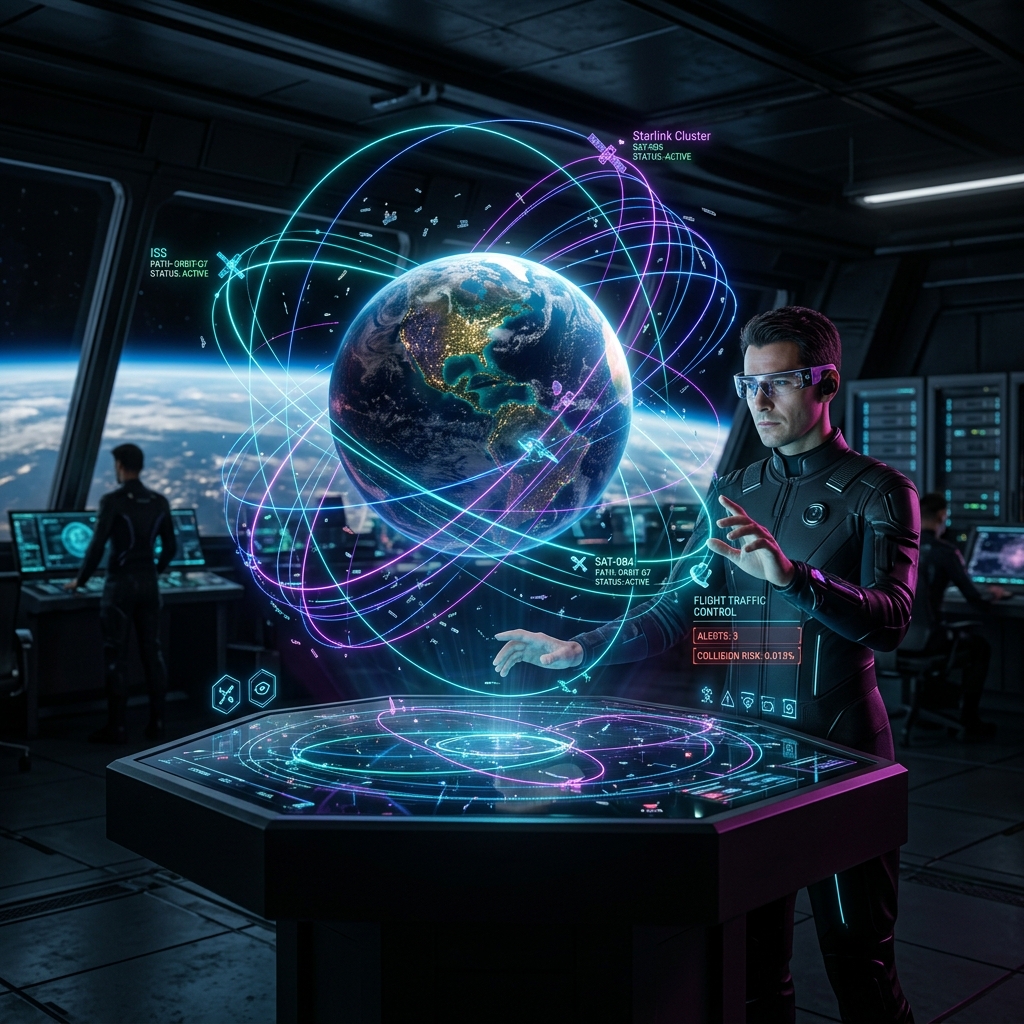
As of 2026, humanity is facing a busier and more congested outer space than ever before. Driven by the surge of low Earth orbit (LEO) mega-constellations led by SpaceX's Starlink and Amazon's Project Kuiper, there are tens of thousands of active satellites orbiting Earth. Consequently, the risk of orbital conjunctions and collisions has increased exponentially.
Collisions between satellites, or between a satellite and space debris, represent a catastrophic threat. Beyond the loss of multi-million dollar equipment, they risk triggering the Kessler Syndrome—a domino-effect chain reaction of collisions that could render orbits completely unusable for generations. To prevent such a space catastrophe, the space industry in 2026 is actively deploying Artificial Intelligence (AI) to revolutionize Space Situational Awareness (SSA) and Space Traffic Management (STM).
In this post, we will take a deep dive into three major AI-driven space traffic management trends currently gaining traction in Google Trends and global space technology conferences.
1. Precision Space Situational Awareness (SSA) via Multi-Modal Data Fusion
Telescopes, radars, and radio frequency (RF) sensors deployed on the ground and in space generate millions of orbital observations daily. However, these datasets have varying margins of error and disparate formats depending on the sensor type, making manual integration and analysis a major bottleneck.
In 2026, AI-powered SSA systems use Multi-Modal Data Fusion to merge and analyze these disparate data streams in real-time.
- Combining Diverse Datasets: The system fuses optical images (which reveal satellite attitude and appearance), radar measurements (which track orbital trajectory), and RF signals (which capture transmission activity).
- Noise Filtration & Enhanced Accuracy: Machine learning algorithms automatically correct sensor noise distorted by adverse weather or space weather (such as solar winds). This has successfully reduced satellite position prediction errors from a scale of meters down to centimeters.
- Debris Classification: ML classifiers categorize tiny debris (under 10 cm) that are normally difficult to track, clustering them by orbital characteristics to systematically organize potential hazards.
2. Onboard Edge AI and Autonomous Collision Avoidance
Communication latency between ground stations and satellites is a critical weakness during urgent orbital collision crises. It can take hours or even days for a satellite to detect a hazard, beam the alert down to Earth, have analysts calculate an avoidance maneuver, and beam the instructions back up.
To address this, satellites are increasingly equipped with radiation-hardened, high-performance AI accelerators, allowing them to make split-second decisions locally using Edge AI.
- Real-Time Onboard Conjunction Analysis: Onboard AI models continuously monitor orbital environments and autonomously calculate conjunction probability with nearby objects.
- Autonomous Avoidance Maneuvers: If the collision probability exceeds a pre-defined safety threshold, the satellite fires its thrusters to execute a temporary avoidance maneuver without waiting for ground control commands, subsequently returning to its original orbit.
- Collaborative Avoidance: Satellites within mega-constellations communicate with each other via inter-satellite laser links. AI agents negotiate which satellite evades in which direction to prevent secondary conflicts.
3. Building 'Trusted AI' Frameworks for Space Traffic Management
As AI takes over the control of satellite paths, a critical question arises: "Can we trust AI's decisions 100%?" Since a malfunction or incorrect prediction could inadvertently cause a secondary collision, safety validation and regulatory compliance have become top priorities.
Consequently, in 2026, international space agencies and private aerospace companies are establishing "Trusted AI" standards and verification frameworks.
- Explainable AI (XAI): Onboard AI systems must provide explainable metrics (e.g., changes in collision probability, fuel efficiency trade-offs) so ground controllers can clearly understand why the AI chose a specific avoidance path.
- Regulation & Standardization: The US Space Force and international space control bodies have enacted strict guidelines for AI-driven collision avoidance algorithms. Only algorithms that pass tens of thousands of simulated conjunction scenarios are certified for autonomous maneuvering.
4. Key Takeaways for Tech Leaders and Innovators
- The Invisible Backbone of Aerospace: While hardware dominated the early days of space commercialization, the software and AI infrastructure that guarantees the safety and sustainability of satellite constellations has become the core competitive edge of the modern space business.
- Spaceward Expansion of Edge Computing: Similar to space-based data centers designed to bypass Earth's power constraints, edge AI technology for local processing will become the standard architecture for future deep-space missions, including Lunar and Martian exploration.
- Emerging Software Market Opportunities: New business frontiers are rapidly opening up for software engineers and startups in areas such as SSA Software-as-a-Service (SaaS), orbital simulation platforms, and communication optimization algorithms.
The era of mega-constellations has gifted us global high-speed satellite internet, but it has also created a giant traffic jam in the sky. To maintain order and enable the next phase of space exploration, AI is no longer a luxury—it is the essential brain managing the new orbital frontier.


Comments
Post a Comment