AWS RNG vs NVIDIA CPO: A Comparative Analysis of Next-Gen AI Data Center Networks
AWS RNG vs NVIDIA CPO: A Comparative Analysis of Next-Gen AI Data Center Networks
The recent announcements of AWS's Resilient Network Graphs (RNG) and NVIDIA's Co-Packaged Optics (CPO) represent two landmark innovations designed to power next-generation, large-scale AI data centers.
While both technologies aim to solve the critical "network bottleneck" of AI clusters, they operate at entirely different layers of the networking stack. In many industry articles, RNG and CPO are framed as competitors, but from an engineering perspective, they are actually highly complementary.
In this article, we will analyze and compare both technologies through the eyes of a network architect, DBRE, SRE, and infrastructure engineer.
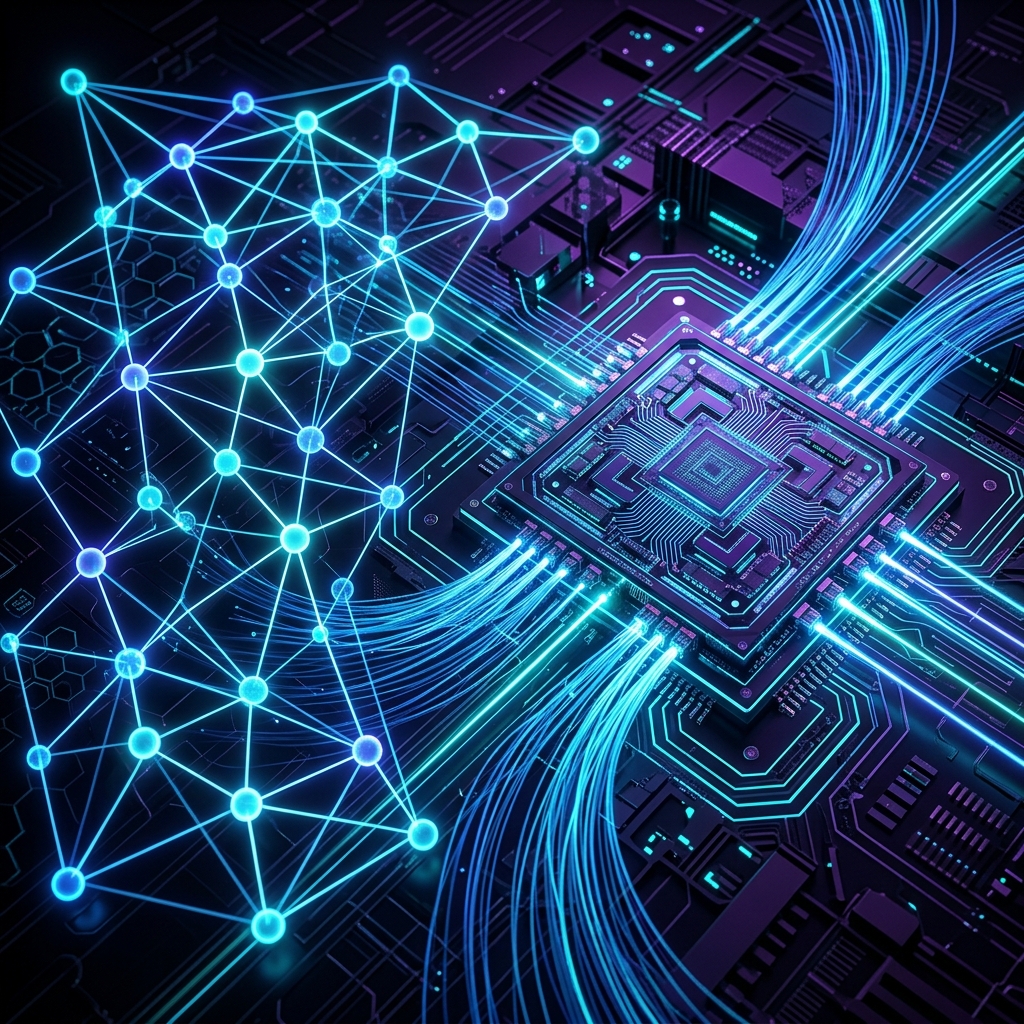
Why Networking Has Become the Bottleneck in the AI Era
In traditional enterprise or web architectures, computing (CPU) or storage was usually the bottleneck. In Large Language Model (LLM) training environments, the paradigm has completely shifted.
Training models like GPT, Gemini, or Claude requires running thousands to hundreds of thousands of GPUs simultaneously. The workload operates in a strict, iterative loop:
GPU Compute ➔ GPU-to-GPU Data Exchange ➔ GPU Compute ➔ GPU-to-GPU Data Exchange
As models scale, the overall training speed is determined more by how fast GPUs can communicate with each other rather than how fast they can compute. This is known as the East-West Traffic problem. The core challenges for AI data centers are:
- Connecting more GPUs (Scalability)
- Minimizing network latency
- Maximizing network throughput
- Drastically reducing power consumption
AWS and NVIDIA address these challenges from two different ends of the spectrum: topology design vs. hardware physical layer integration.
AWS RNG (Resilient Network Graphs)
AWS’s approach focuses on topology innovation. Traditional data centers rely on hierarchical, tree-like Clos (often called Fat-Tree) network architectures.
While Clos topologies are scalable and easy to build, they face major limitations at AI-scale:
- Exponential increases in the number of switches
- Congestion hot-spots at specific Spine switches
- Higher hop counts leading to increased latency
- Prohibitive cabling costs and massive failure blast radiuses
To overcome this, AWS leveraged graph theory to replace the rigid Fat-Tree with a Random Regular Graph (RNG) topology.
Three Key Breakthroughs of RNG
1. Path Diversity and Latency Reduction
Instead of routing traffic through a rigid hierarchy, RNG connects switches in a quasi-random graph layout. This drastically increases the number of available paths between any two racks, maximizing ECMP (Equal-Cost Multi-Path) routing efficiency and allowing the network to dynamically reroute around congestion or hardware failures.
2. Overcoming Cabling Chaos: The ShuffleBox
The main barrier to implementing random graph networks historically has been the cabling. Manually routing tens of thousands of optical cables without a neat structure is a cabling nightmare. AWS solved this by developing a passive optical routing box called the ShuffleBox, which handles the complex randomized internal routing automatically.
3. Drastic Hardware and Cost Reduction
According to AWS, replacing Clos networks with RNG delivers significant infrastructure savings:
- ~69% reduction in network equipment (switches/routers)
- ~33% increase in network throughput
- ~40% reduction in networking power usage
- ~45% lower network build costs
RNG has become the default architecture for new non-GPU AWS data centers, dramatically streamlining global cloud backbone operations.
NVIDIA CPO (Co-Packaged Optics)
While AWS is redesigning the network's roadmap (topology), NVIDIA is replacing the physical engine (physical layer) of the network components themselves.
The Limits of Pluggable Optics (The I/O Bottleneck)
In contemporary AI data centers, connections between switches and GPUs rely on pluggable optical transceivers. However, as speeds jump to 800G, 1.6T, and 3.2T, transmitting high-frequency electrical signals over copper PCB traces requires power-hungry Retimers and Digital Signal Processors (DSPs) to maintain signal integrity, pushing power budgets to their limit.
What is CPO?
Co-Packaged Optics (CPO) solves this by eliminating the traditional pluggable transceiver module on the front panel. Instead, it packages the optical engine directly alongside the switch ASIC or GPU on a single substrate.
This shortens the electrical trace length from inches to millimeters, removing the need for power-hungry retimers and DSPs.
Three Key Breakthroughs of CPO
1. Extreme Power Efficiency (3.5x to 5x Savings)
By drastically shortening the distance electrical signals must travel before converting to light, CPO eliminates the need for signal-boosting chips. This achieves a 3.5x to 5x improvement in power efficiency over traditional pluggable transceivers.
2. Integration of Silicon Photonics
CPO leverages silicon photonics fabrication techniques to embed microscopic optical components directly on the silicon die. This yields superior signal integrity, extremely high bandwidth density, and lower transmission latency.
3. Enabler for Million-GPU AI Factories
To scale AI clusters to hundreds of thousands or even millions of GPUs, traditional copper and pluggable optical networks are too power-heavy and slow. By embedding CPO into their networking platforms (like Spectrum-X and Quantum-X), NVIDIA is breaking the physical limits of high-performance scale-up interconnects.
Comparison: AWS RNG vs. NVIDIA CPO (Co-Packaged Optics)
RNG and CPO target different challenges at different layers of data center architecture.
| Feature | AWS RNG (Resilient Network Graphs) | NVIDIA CPO (Co-Packaged Optics) |
|---|---|---|
| Layer | Network Topology (Logical Layout) | Physical & Packaging Layer (Hardware) |
| Focus | How switches and racks are interconnected | How signals are converted and transmitted |
| Primary Challenge | Rigid tree paths, excess switches, and scale limits | Power wall, signal attenuation, and I/O bottlenecks |
| Core Technology | Random Graph Theory, physical ShuffleBox | Silicon Photonics, On-Package Optical Engines |
| Key Metrics | -69% hardware, -40% power, +33% throughput | 3.5x–5x better transmission efficiency, ultra-low latency |
To use an analogy, AWS is redesigning the roadmap of the city from gridlock-prone avenues to a highly efficient bypass network, while NVIDIA is replacing the internal combustion engines in the cars with high-efficiency electric motors.
Future Outlook: The Synergy of RNG and CPO
Future AI Factories will not choose between RNG and CPO. Rather, they will deploy them together to overcome the double bottleneck of routing path efficiency and physical power consumption.
The blueprint for future AI data center networks will look like this:
[Intelligent AI Routing / SDN Control Layer]
                       │
[RNG-based Random Graph Network Topology]
                       │
[CPO-based Ultra-efficient Silicon Photonics Physical Layer]
                       │
[Massive GPU Cluster (AI Factory)]
In this unified ecosystem, NVIDIA's CPO provides the ultra-low-power, high-density physical optical pipes, while AWS's RNG simplifies the network layout, eliminating unnecessary switch hops and equipment. At the top, SDN/AI Routing directs traffic dynamically through the optimal graph paths.
Conclusion
For infrastructure professionals, AWS RNG is an evolution of software and network architecture design, while NVIDIA CPO is a revolution in hardware physical engineering.
Architects building the massive compute grids of tomorrow must look beyond raw port speeds and understand graph-based network topologies, silicon photonics packaging, and dynamic routing protocols to successfully design next-generation AI infrastructure.


Comments
Post a Comment