Google Trends 2026: The Convergence of AI and Space Technology — From Onboard Edge AI to Orbital Data Centers
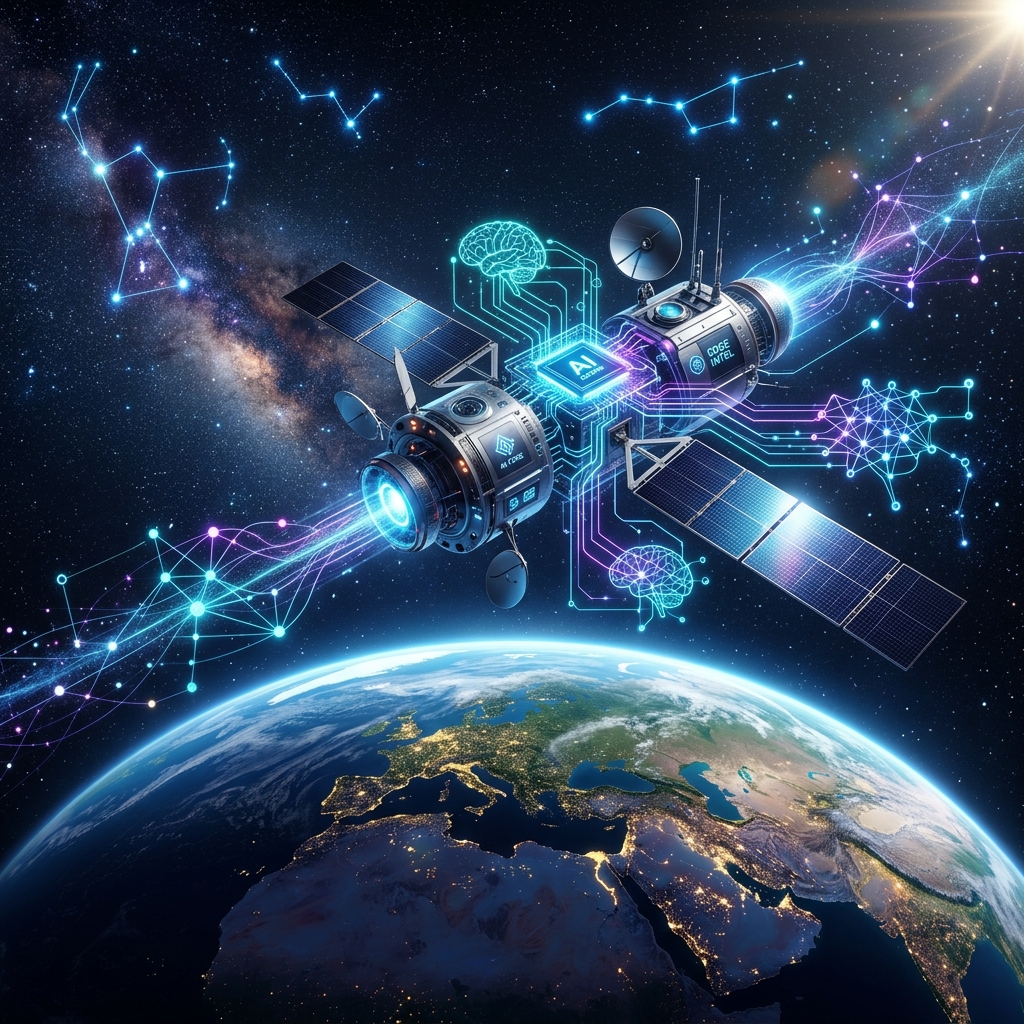
Google Trends 2026: The Convergence of AI and Space Technology — From Onboard Edge AI to Orbital Data Centers
"Artificial intelligence, once bound to Earth, is heading into orbit. In 2026, AI and space technology are shattering each other's limitations, forming the absolute frontier of technological innovation."
A New Compass Pointed by Google Trends: AI + Space
According to recent Google Trends analyses, search traffic exploring the technological intersection of "Artificial Intelligence (AI)" and "Space Exploration" has spiked dramatically over the past few months, transcending interest in either individual keyword.
This trend is fueled by the commercialization of the space industry (the "New Space" era) alongside the rapid advance of Large Language Models (LLMs) and highly optimized, small-footprint AI models. In 2026, we explore the four core trends in AI-driven space technology capturing the attention of the global tech sector and aerospace academia, highlighting key technical and business insights.
1. Edge AI and Onboard Processing: Overcoming Deep-Space Latency
One of the greatest bottlenecks in space exploration is communication latency. A round-trip signal to the Moon takes about 2.5 seconds, while a one-way transmission to Mars can range from 4 to 24 minutes depending on planetary alignment. In an emergency, a spacecraft or rover cannot afford to wait for commands from Earth.
To address this, Onboard Edge AI—running locally on the spacecraft to make real-time decisions—has emerged as a foundational trend.
📌 Technical Implementation & Shifts
- Autonomous Navigation: NASA's Perseverance rover utilizes an onboard AI-driven path-planning system to identify and navigate around hazardous Martian terrain autonomously. This vastly increases the science return per command cycle (Sol).
- Radiation-Hardened Chips: High-performance, radiation-hardened AI processors capable of enduring extreme space environments are transitioning to commercial deployment. These chips enable satellites to reliably process trillions of operations per second (TOPS) in orbit.
2. The Rise of Orbital Data Centers
Training and running generative AI models on Earth consumes massive amounts of electricity and water for cooling, raising severe sustainability concerns. As a green alternative, the concept of Orbital Data Centers in Low Earth Orbit (LEO) is fast becoming a reality.
📌 Why Space? (Terrestrial vs. Orbital Data Centers)
| Feature | Terrestrial Data Centers | Orbital Data Centers |
|---|---|---|
| Power Supply | Fossil fuels & grid renewables (heavy carbon footprint) | Infinite Solar Power (continuous 24/7 solar exposure) |
| Cooling System | Energy-intensive HVAC and liquid chillers | Ultra-cold Vacuum of Space (leveraging natural radiative cooling) |
| Land & Regulations | High real estate costs and environmental regulatory constraints | No land footprint (launch and orbital insertion costs are the primary variables) |
With mega-constellations like SpaceX’s Starlink acting as high-speed communication backhauls, orbital data centers can process computationally heavy AI workloads in space and beam the insights back to Earth, establishing a clean space-based computing architecture.
3. Satellite Constellation Management and Orbital Traffic Control
Thousands of active communication satellites populate Low Earth Orbit, and tens of thousands more are scheduled for launch. Managing orbital paths and avoiding collisions has grown far too complex for manual human control.
📌 AI-Powered Orbital Traffic Solutions
- Autonomous Collision Avoidance: AI algorithms process real-time orbital data and debris trajectories to autonomously perform avoidance maneuvers using minimal thruster fuel.
- Direct-to-Device (D2D) Optimization: Connecting standard 5G/6G cell phones directly to LEO satellites introduces severe packet loss and doppler shifts. AI-driven beamforming dynamically optimizes the radio links to ensure seamless connectivity.
4. Accelerating Scientific Discovery via Agentic AI
Deep-space observatories like the James Webb Space Telescope and Earth-observation satellites generate petabytes of data daily. Analyzing this data manually would take scientists multiple lifetimes.
Google, NASA, and other research institutions are co-developing Agentic AI systems that can autonomously formulate hypotheses, filter noise, and discover candidate exoplanets. NASA’s exoplanet validator, ExoMiner, has successfully confirmed hundreds of exoplanets by detecting extremely subtle transit signals that human analysts might easily overlook.
💡 Key Insights for Tech Leaders and Engineers
The convergence of AI and space tech offers critical lessons for terrestrial industries:
- The Resurgence of Embedded and Edge Engineering: As we design systems for resource-constrained environments, engineers must move away from relying on infinite cloud resources. The ability to design lightweight, fault-tolerant AI architectures optimized for low power is becoming a differentiator.
- In-situ Data Processing: The era of downlinking raw, massive datasets for processing is ending. Hybrid architectures that perform initial analysis in-situ (locally) and transmit only the extracted insights will expand from space to other remote, harsh environments on Earth, such as polar stations and industrial factories.
- A Broader View of Sustainable Infrastructure: Rather than restricting infrastructure roadmaps to terrestrial boundaries, forward-thinking organizations should consider space orbit as a viable, sustainable tier in their long-term architectural plans.
"Space is the ultimate sandbox for testing the survival limits of artificial intelligence. AI technologies forged in the harsh environment of orbit will ultimately return to revolutionize our terrestrial businesses."
To stay updated on the frontier of technology trends and global tech insights in 2026, subscribe to our newsletter!


Comments
Post a Comment