Space Edge AI: The RISC-V Revolution and the Rise of Software-Defined Satellites
Space Edge AI: The RISC-V Revolution and the Rise of Software-Defined Satellites
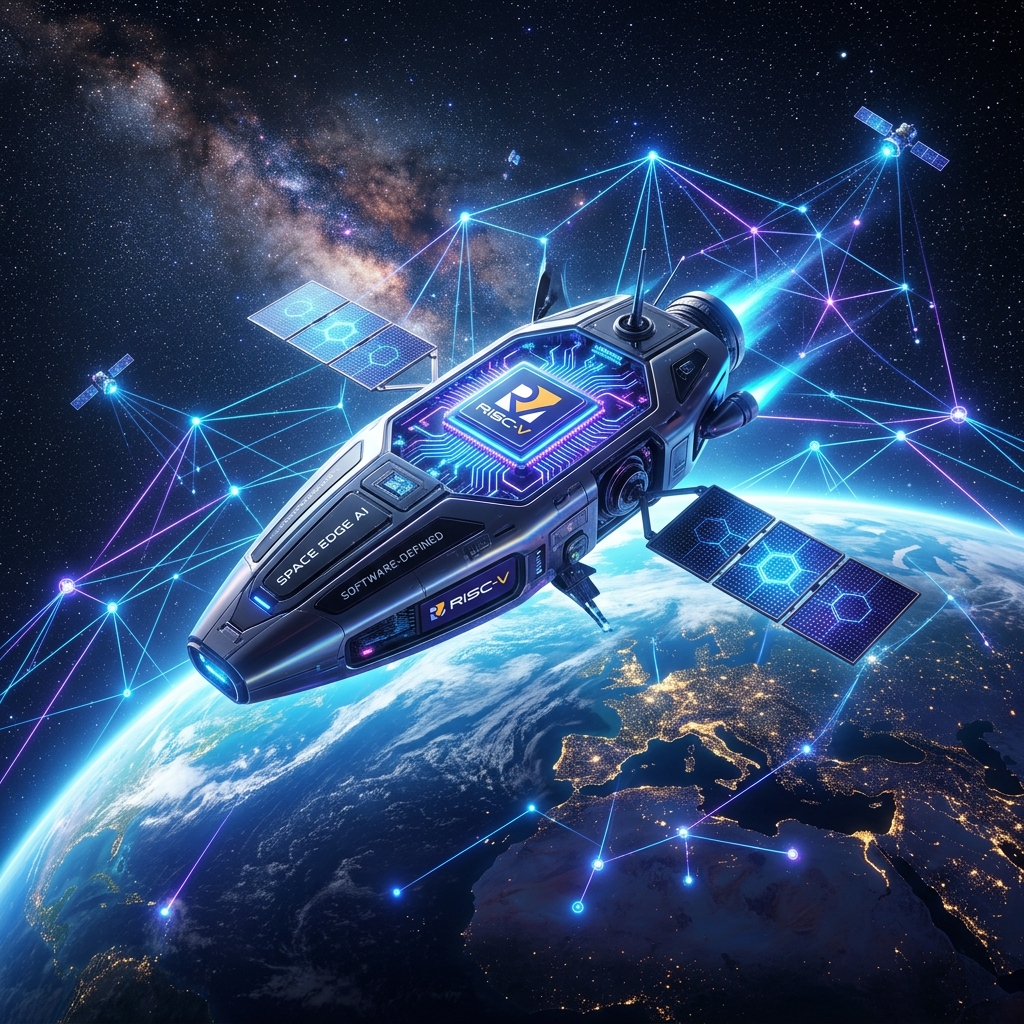
As of mid-2026, the convergence of Artificial Intelligence (AI) and space technology has moved beyond speculative engineering and entered a phase of operational integration and industrial maturity. Recent Google Trends data reveals a steady climb in search volume for AI and space technology. This indicates that industry focus is shifting from basic launch vehicle competitions toward a fundamental transformation of software and hardware architectures—a paradigm known as "Orbital Computing."
In the past, satellites functioned primarily as simple "bent-pipe" relays, either repeating signals or downlinking massive raw data streams for ground processing. Today, satellites are being reborn as autonomous edge AI systems capable of independent inference and real-time processing directly in orbit.
In this post, we delve deep into the RISC-V hardware architecture and Software-Defined Satellites driving this space edge AI revolution, while highlighting key technical insights from the ongoing global race for orbital dominance.
1. The Space Data Explosion and the Ground Station Bottleneck
With rapid advancements in onboard sensors, high-resolution cameras, and Synthetic Aperture Radar (SAR), the volume of data generated in space is growing exponentially. However, downlinking this data to Earth-bound stations is limited by strict physical constraints:
- Bandwidth Limitations: A satellite's ground station pass time—the window during which it can establish a direct line-of-sight communication link—is typically restricted to a few minutes, a handful of times per day.
- Latency Challenges: Deep-space missions, and even Low Earth Orbit (LEO) constellations, suffer from signal propagation delays ranging from seconds to minutes due to the speed of light and network relay hops.
- Prohibitive Transmission Costs: Constantly sending terabytes of raw telemetry and imagery down to ground servers requires immense energy and financial resources.
The only viable breakthrough is onboard data processing—extracting actionable intelligence at the edge and transmitting only the synthesized insights back to Earth. This requirement has spurred the rise of Orbital Computing, converting spacecraft into orbiting edge data centers.
2. The Hardware Revolution: Why Space is Aligning with RISC-V
Historically, spaceflight computers have relied on ultra-conservative, radiation-hardened designs to survive the harsh solar radiation environment. For instance, the RAD750 processor used in NASA's Mars rovers is based on a 1990s PowerPC architecture and operates at a mere 133 to 200 MHz. This level of processing power cannot support modern deep learning models, let alone basic real-time image compression.
To close this performance gap, the industry is turning to RISC-V as a primary hardware game-changer.
2.1 NASA and Microchip’s PIC64-HPSC
NASA has designated the open-source RISC-V ISA as the standard architecture for next-generation space exploration. Developed in partnership with Microchip, the PIC64-HPSC (High-Performance Spaceflight Computing) system-on-chip (SoC) delivers over 100 times the computational performance of the legacy RAD750.
- Open Standard ISA: Because it is independent of proprietary intellectual property (IP), engineers can customize vector extensions and deep learning accelerators optimized specifically for space radiation environments.
- Built-in Fault Tolerance: Radiation hardening is integrated at the silicon level, combining high-speed multicore capability with advanced error correction and hardware-level fault isolation.
2.2 Europe's TRISTAN Project and ESA's NOEL-V
The European Union is also actively adopting RISC-V to ensure strategic autonomy in space technology. The European Space Agency (ESA) has developed the NOEL-V IP core, a 16-core processor architecture, and has entered a production-ready phase via the TRISTAN consortium (2023-2026) to deliver radiation-hardened SmallSat microprocessors.
By standardizing spaceflight hardware on an open-source architecture like RISC-V, space agencies and commercial operators are driving down manufacturing costs while streamlining the porting of advanced neural networks directly onto space-bound chips.
3. Software-Defined Satellites and On-Orbit AI Agents
This dramatic leap in compute power has decoupled satellite capabilities from fixed hardware. Satellites deployed in 2026 are software-defined, meaning ground teams can update missions, deploy new workloads, and patch AI models via Over-The-Air (OTA) transmissions.
Real-World Use Cases for On-Orbit Edge AI:
- Intelligent Earth Observation: Earth-observation cameras take millions of images, but many are obscured by clouds. Onboard AI classifiers automatically filter out these useless images at the edge. By transmitting only clear, cloud-free images (under 1% of raw captures), operators save up to 99% of satellite bandwidth.
- Autonomous Collision Avoidance: Megaconstellations like SpaceX’s Starlink navigate crowded low Earth orbits. Instead of waiting for ground control commands, satellites run real-time local collision avoidance algorithms to detect orbital debris and autonomously adjust their trajectories.
- Dynamic Beam Steering and Inter-Satellite Link (ISL) Routing: Satellites dynamically steer radio beams to match localized user demand and optimize laser communications between satellites using machine learning algorithms.
4. The Geopolitical Race for Space AI Dominance
The race to secure the software-defined orbital computing layer is dividing the globe into three major ecosystems:
- United States (Commercial Dominance): Silicon Valley leads commercialization, deploying orbital edge nodes based on space-adapted NVIDIA Jetson platforms over massive LEO constellations to run commercial AI models on-orbit.
- China (Three-Body Computing Cluster): China is accelerating the deployment of its "Three-Body Computing Cluster" within its national space network to enable decentralized edge computing and autonomous swarm routing.
- European Union (IRIS² Sovereignty): The EU is developing the IRIS² satellite constellation, emphasizing secure, sovereign communications and utilizing RISC-V processor architectures to maintain technology independence.
5. Key Insights for Developers and Tech Innovators
The rise of space edge AI and the RISC-V revolution offers valuable lessons for terrestrial technology ecosystems:
- The Rise of "Space DevOps": Satellite missions are shifting to containerized (Docker, WebAssembly) microservice deployments, where AI models are continuously integrated and deployed (CI/CD) in orbit. Satellite development is now a software architecture battleground.
- The Ultimate Validation for RISC-V: If RISC-V can prove its resilience and multicore processing capabilities in the extreme radiation and thermal swings of space, it will accelerate its adoption in safety-critical terrestrial edge applications—such as autonomous vehicles, smart manufacturing, and defense systems.
- API-Driven Space Infrastructure: The "Satellite-as-a-Service" model allows developers to rent space computing resources through cloud APIs, bypassing the need to build expensive ground infrastructure. This reduces the entry barrier and will spark a new wave of innovative software startups.
Conclusion
Space is no longer a distant, unreachable vacuum; it has become the ultimate edge network at the periphery of our global digital infrastructure. The open-source democratization of hardware via RISC-V, combined with software-defined design, is rewriting the rules of space exploration. For engineers and tech innovators, now is the time to start thinking about distributed systems that span not just terrestrial networks, but the entire orbital boundary.


Comments
Post a Comment