The Real Bottleneck of the AI Era: Power Grids, Not GPUs (South Korea's 260k GPUs vs. Japan's Policy Differences)
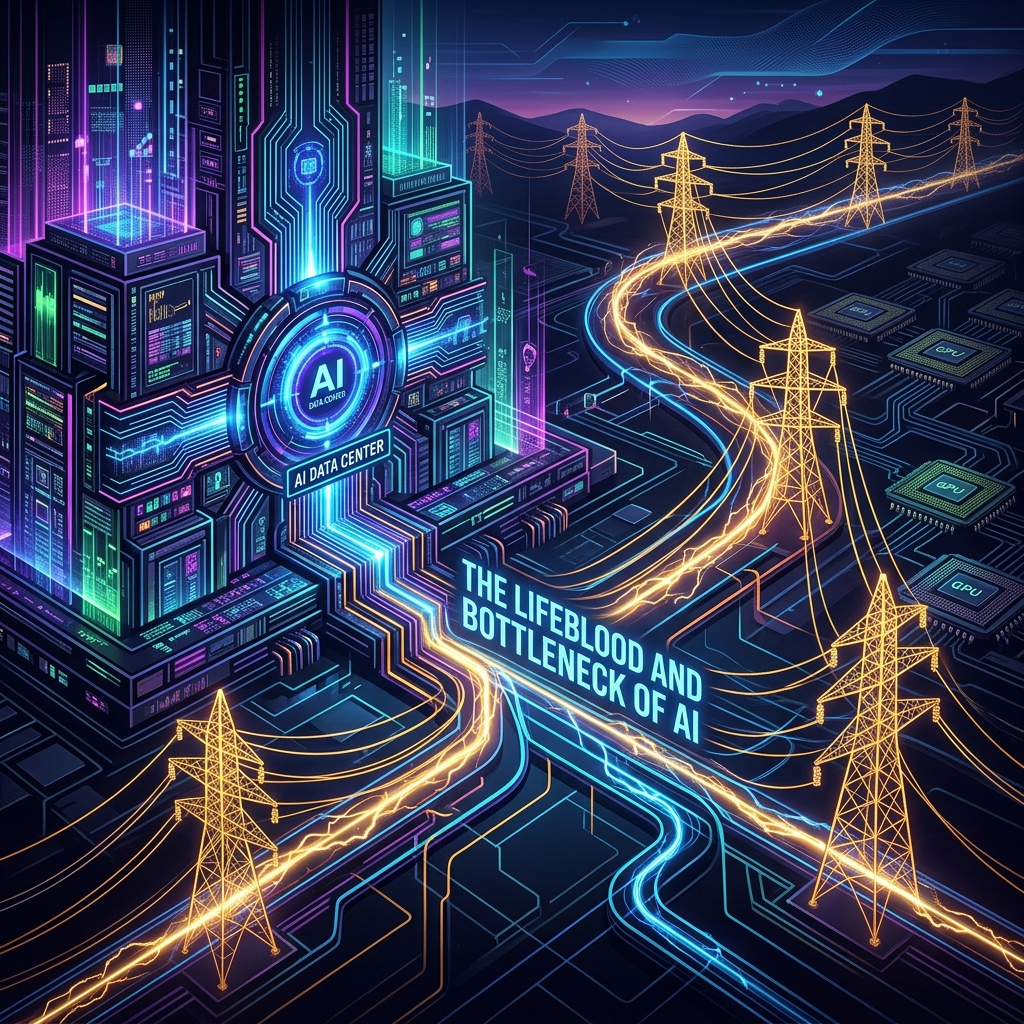
The Real Bottleneck of the AI Era: Power Grids, Not GPUs
Centering on South Korea's 260k GPU Plan and Japan's Power Awareness Differences
When discussing AI infrastructure competition, we usually look at the number of GPUs first. News focuses on how many NVIDIA GPUs a country has secured, how much Blackwell a company is adopting, and the scale of AI supercomputers being built in EFLOPS.
However, recent situations show that the real bottleneck might not be the GPUs themselves. Even if you secure GPUs, you cannot run any of them unless you have data centers to plug them into, power to supply to those data centers, and a transmission grid to send that power to the actual locations.
The announcement that South Korea has decided to secure GPU infrastructure on a scale of over 260,000 units from NVIDIA clearly illustrates this issue. According to NVIDIA's official announcement, the Korean government, Samsung Electronics, SK Group, Hyundai Motor Group, and NAVER Cloud will collectively build an NVIDIA GPU infrastructure exceeding 250,000 units. Specifically, a composition is presented: over 50,000 units for the government and cloud service providers, over 50,000 units for Samsung Electronics, over 50,000 units for SK Group, 50,000 units for Hyundai Motor Group, and over 60,000 units for NAVER Cloud.
This number represents a massive opportunity for the Korean AI industry. However, it also raises a question:
"Where, with what power, and in how many years can we actually run these GPUs?"
260,000 GPUs is Not Just a Server Purchase
A figure like 260,000 units is not simply a matter of adding equipment to a server room. Blackwell-class GPUs consume a vast amount of power per unit, and clustering them into racks requires a power density completely different from traditional data centers.
The power consumption of NVIDIA's latest GPU racks is rising from tens of kW in the early 2020s to over 100 kW in 2025, and racks in the hundreds of kW range are entering the practical horizon. Korea Electric Power Corporation (KEPCO) officials have also pointed out the rising power density of AI data centers, mentioning that the era in which a single data center consumes power equivalent to a nuclear power plant (around 1 GW) is not far off.
Calculating the power for 260,000 units itself leads to hundreds of MWs just for the GPUs. When adding CPUs, memory, storage, networks, power conversion losses, cooling, UPS, and substation facilities, the total load on the data center becomes far larger. This is why various reports and analyses estimate that an AI infrastructure on the scale of 260,000 GPUs could require around 500 to 800 MW of power.
The key point here is not that South Korea lacks data centers. South Korea already has commercial data centers and cloud infrastructure. The question is whether existing data centers are structured to immediately accommodate 260,000 units of new AI GPUs.
A general data center and an AI factory have different requirements. GPU clusters for AI training require high-density racks, high-power ingress, liquid cooling, high-speed network fabrics, large-scale substation facilities, and stable power quality simultaneously. Therefore, it cannot be solved simply by saying, "Since we bought the GPUs, let's put them in existing centers."
To be precise, the problem in South Korea is not "there are no centers," but "can we prepare high-density AI data centers and power infrastructure quickly enough to accommodate 260,000 new AI GPUs?"
The Real Bottleneck is "Location of Power" Rather Than Generation Capacity
When discussing AI data center power issues, people often ask, "Is there a electricity shortage?" But the more accurate question is, "Can we supply the necessary power to the required place at the required time?"
In South Korea's case, power plants are mainly located in non-metropolitan areas, while data center demand is heavily concentrated in the Seoul metropolitan area. This is because cloud, AI inference, finance, internet services, corporate clients, and professional talent are concentrated in the metropolitan area. In particular, AI inference centers strongly prefer metropolitan locations to minimize latency for users.
Conversely, the metropolitan area has low power self-sufficiency and limited transmission grid margin. KEPCO officials pointed out that while about 70% of new power connection applications are concentrated in the metropolitan area, the region is structured to draw electricity from outer regions. Furthermore, building a 345kV transmission line typically takes about 13 years, whereas data centers or renewable energy facilities can be built within 2 to 3 years.
This time gap is the core issue. GPU procurement and data center construction can proceed relatively quickly, but transmission lines and substations take much longer due to local acceptance, licensing, compensation, environmental reviews, and construction periods.
In other words, the power issue is not "something to think about later when there is more equipment." From the moment you plan an AI data center, you must check power connection availability, substation locations, grid expansion plans, cooling methods, and the possibility of regional distribution.
When Should Power Supply Be Considered?
To conclude, companies planning to build AI data centers or large-scale GPU clusters must consider power supply starting now. Especially if you are looking at a scale of 10MW, 50MW, or 100MW or more, rather than a small-scale GPU server room of 1-2MW, power review must come at the very beginning of business planning, not the end.
Depending on the scale, we can break it down as follows:
First, for in-house AI servers with tens to hundreds of GPUs, existing IDCs, clouds, and colocation can be utilized. In this case, power is important, but it may not be a bottleneck that determines the fate of the entire project. However, if you are installing high-density racks, you must verify the power limits per rack and cooling constraints.
Second, when it comes to thousands of GPUs, power is already a key review item. At this stage, you must calculate the power per rack, total IT load, PUE, cooling methods, power ingress capacity, and redundancy configurations before looking at equipment quotes. Even if you move into an existing data center, you may not secure as much high-density space as you want.
Third, at a scale of tens of thousands of GPUs, it practically becomes a power infrastructure business rather than a data center business. At this stage, power contracts, substations, transmission grids, land, cooling water, community acceptance, and permit timelines become more important than GPU prices.
Fourth, national plans for hundreds of thousands of GPUs must look at grid planning and industrial policy together. The announcement of GPU adoption alone is not enough. You must design how many MWs can be supplied to which regions and when, how to divide the metropolitan and non-metropolitan areas, and how to distribute AI training and inference workloads.
Therefore, the answer to the question "When should power be considered?" is clear.
In large-scale AI infrastructure, power is not a post-consideration but a prerequisite that must be finalized before purchasing GPUs.
Why Has the Power Issue Suddenly Surged in Korea?
The reason this issue has suddenly grown in South Korea is triggered by the NVIDIA 260,000 GPU announcement. South Korea is strong in semiconductors, manufacturing, telecommunications, internet platforms, and the automotive industry. The demand to apply AI to manufacturing, robotics, autonomous driving, semiconductor fabrication processes, communication networks, and the cloud is also huge.
However, when all these demands request GPU infrastructure simultaneously, the power grid bottleneck is exposed. In particular, metropolitan data center permits and power connection issues are already becoming reality. According to recent Korean media reports, a significant number of metropolitan data center power supply reviews are failing, and cases of passing in Seoul are extremely rare. Although the passing rate is relatively high in non-metropolitan areas, data center-seeking companies still desire metropolitan accessibility.
Ultimately, Korea's structural problems are as follows:
- Demand is in the metropolitan area.
- Power is generated in non-metropolitan areas.
- The transmission grid does not expand quickly.
- AI data centers require much more power than traditional data centers.
- The speed of GPU introduction is faster than the speed of transmission grid expansion.
Under this structure, the actual utilization rate of GPUs may be limited even if they are secured. Even if equipment is brought in, power ingress might be delayed, or it may not be possible to run all equipment at maximum performance simultaneously due to peak power limits.
Japan Views It in a Slightly Different Way Than Korea
Japan is facing the same problems, but its perception is slightly different from Korea's. While Korea's issue surged rapidly after the NVIDIA 260,000 GPU and AI factory announcements with the question "We have GPUs, but do we have power?", Japan approaches the issue from the perspective of how the increase in data centers and semiconductor factories might drive up long-term electricity demand.
Japan's Ministry of Economy, Trade and Industry (METI) requires operators to report data center electricity usage, PUE, and energy consumption intensity starting from the FY2026 submissions, and requires some information to be disclosed by operators. It also proposed a direction to require a stricter efficiency standard of PUE 1.3 or less for new data centers built after FY2029. Previously, the target was PUE 1.4 or less by FY2030, but a higher standard is being applied to new centers.
Furthermore, in response to the increase in AI data centers, Japan is reopening discussions on nuclear power plant reconstruction and power supply stability. According to a Reuters report, METI released a policy proposal suggesting that the reconstruction of 2 to 5 aging nuclear reactors by the 2040s and up to 14 reactors by the 2050s might be necessary. The background is the surge in power demand due to AI data centers.
In other words, Japan views this issue not as a "GPU procurement race," but as "long-term electricity demand, data center efficiency, location distribution, and energy policy including nuclear, renewable energy, and transmission grids."
While Korea has begun to rapidly recognize the power bottleneck from the perspective of industrial policy and AI competition, Japan can be seen as responding in a relatively institutionalized manner from the perspective of energy policy and efficiency regulations.
In the Future, MW Will Be More Important Than GPU Count
The metrics of AI infrastructure competition are changing. In the past, "how many GPUs have you secured?" was important. In the future, "how many MWs have you secured?", "when is the grid connection possible?", "how many kW can be stably cooled per rack?", "what is the PUE?", and "what is the electricity rate?" will be more important.
Particularly, AI training runs large-scale GPUs at high loads for long periods. AI inference creates continuous power demand as the number of users grows. If AI agents, video generation, robotics, autonomous driving, and digital twins spread, GPU usage will increase further. The problem is that AI infrastructure does not expand automatically just because semiconductor production capacity increases.
- GPUs can be manufactured in factories, but power grids cannot be built that quickly.
- GPUs can be delivered in months, but transmission grids can take years to more than a decade.
- Servers can be purchased, but power connection rights and local acceptance cannot be solved with money alone.
This is why power will become a bottleneck in the AI industry.
What Companies Should Do Now
If you are a company preparing AI infrastructure, you must check the following items first, rather than just looking at the GPU quotation:
- Calculate the total required IT load in MW. You must estimate the actual facility power including GPU quantity, server configuration, network, storage, CPU, memory, and cooling methods.
- Estimate PUE conservatively. Even if liquid cooling is applied, ideal figures may not be achieved in the early stages of operation. Power design must not be optimistic.
- Divide workloads into those that absolutely require metropolitan location and those that can be sent to non-metropolitan areas. A hybrid structure is needed, such as sending large-scale training to regions with good power conditions and placing low-latency inference close to users.
- Align the power connection availability timeline with the GPU deployment schedule. If GPUs arrive first and power is prepared later, assets will sit idle. Conversely, if power is secured but GPUs are delayed, data center investment efficiency drops.
- Consider grid-friendly operations. AI training tasks are often time-shiftable. Avoiding peak electricity hours, shifting workloads by region, or utilizing UPS and ESS to reduce grid load will be important in the future.
Conclusion: AI Infrastructure is Now a Power Industry
South Korea's 260,000 GPU plan is an opportunity for the AI industry, but at the same time, it is a case that exposes the limitations of power infrastructure. We should not simplify this issue as "there are no data centers in Korea." Korea already has data centers. However, to run 260,000 new AI GPUs stably at high density, a power infrastructure of a different scale is required.
The key is location and timing rather than the total amount of electricity. Supplying power of the required quality at the required place and time is becoming the core of AI competitiveness.
Korea is quickly recognizing the power bottleneck sparked by securing NVIDIA GPUs. Japan is linking the increase in data center power demand to long-term energy policy, PUE regulations, and nuclear power reconstruction discussions. The approaches are different, but the conclusion is the same.
The future AI competition is both a GPU competition and a power grid competition. Many countries will be able to secure GPUs. However, only a limited number of countries will have the power and transmission grid to run those GPUs stably.
Therefore, companies and countries planning AI infrastructure must look at power starting now. It is not an auxiliary condition that can be considered later, but a core condition that must be finalized before GPU introduction.


Comments
Post a Comment