Why Is Korea's IT Outsourcing Market So Competitive While Japan Commands Higher Rates?
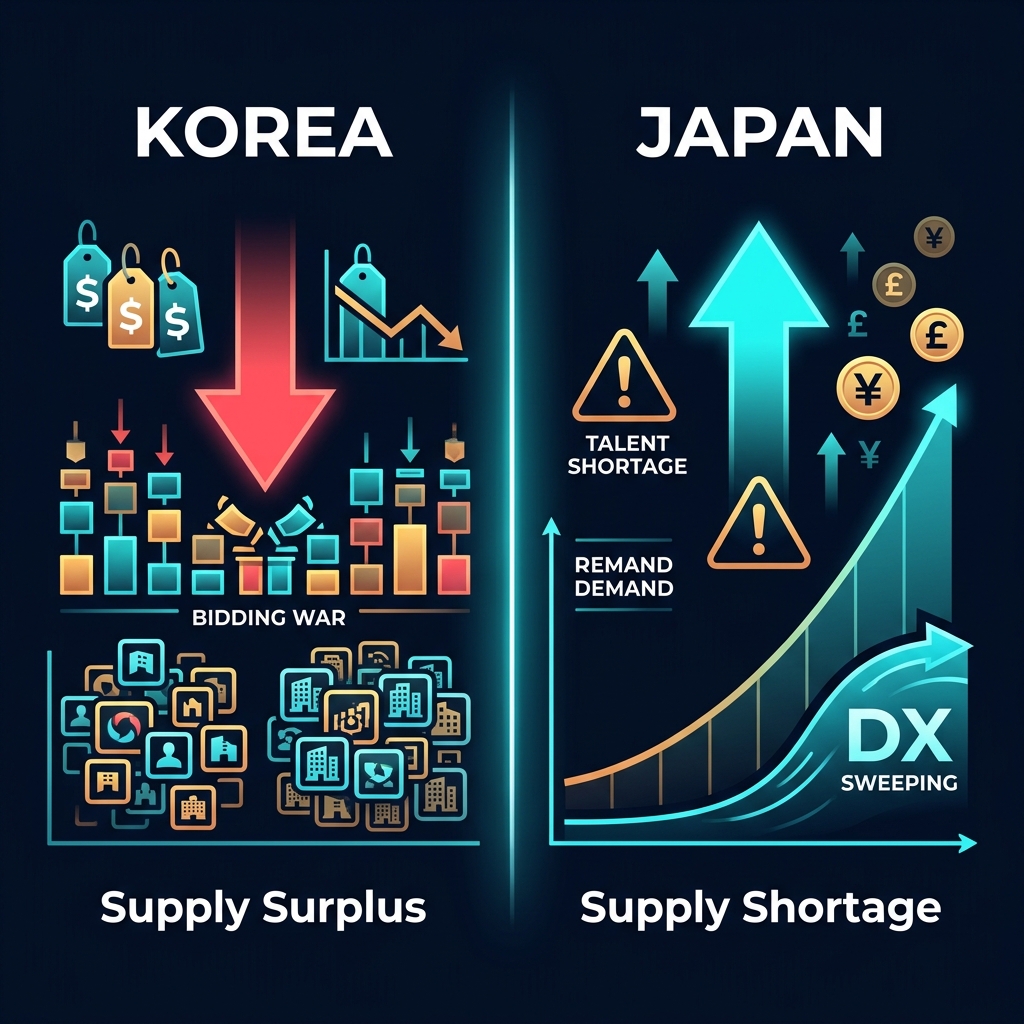
Both Korea and Japan are nations with highly developed IT industries. Yet anyone who has worked in the IT outsourcing market will notice a striking difference in the atmosphere between the two countries.
In Korea, development, operations, DBA, cloud infrastructure, and MSP services are exposed to intense price competition. In Japan, however, competition tends to be less fierce, and the same level of technical service often commands significantly higher rates.
Many people attribute this simply to "Japan being expensive," but the real cause lies in market structure.
What Matters More Than Market Size Is the Balance of Supply and Demand
Let's start with market size.
As of 2025, Korea's IT services market is valued at approximately $25–30 billion USD. Japan's IT services market, on the other hand, is estimated at over $70–80 billion USD — roughly 2 to 3 times larger than Korea's.
The problem, however, is the number of suppliers.
In Korea, the barrier to entry for starting an IT outsourcing company is extremely low. A handful of developers can form an SI firm, MSP company, or web agency. As a result, countless small and mid-sized IT vendors compete for the same pool of customers.
Japan also has many suppliers, but its market is far larger, and crucially, customer demand is outpacing the rate of supply growth.
In short, Korea is a supply-saturated market, while Japan is closer to a supply-deficient market.
This is the fundamental starting point for all the differences that follow.
In Korea, Price Gets Compared Before Skill Does
A common phenomenon in Korea's IT outsourcing market is bid competition.
Customers request quotes from multiple vendors simultaneously.
The first thing compared is price, not the quality of the proposal.
If technical differences are perceived as minor, the cheapest vendor wins.
In this structure, suppliers are forced to continuously lower prices just to survive.
Profitability shrinks, and lower margins lead back to talent shortages and quality degradation.
This vicious cycle is particularly pronounced among small and mid-sized SI and MSP companies.
It's also why technically superior companies in Korea don't always generate superior profits.
Japan Isn't Less Competitive — It's Just Running Out of People
The biggest misconception Korean companies hold about the Japanese market is that "competition is low."
That's not quite accurate.
Japan has an abundance of SI and IT service companies.
The difference isn't in the number of suppliers — it's in the number of available workers.
Japan's Ministry of Economy, Trade and Industry (METI) projects a shortage of up to 790,000 IT professionals by 2030.
This isn't just a hiring challenge. For businesses, it means being unable to find the talent they need at all.
In Korea, a company can review dozens of applicants for a single DBA position.
In Japan, it's common to run a job posting for months without finding a qualified candidate.
So companies turn to outsourcing. And outsourcing vendors have no reason to lower their prices — demand exceeds supply.
Japan Still Has a Strong Culture of IT Outsourcing
Another key difference lies in IT organizational culture.
Korean companies are increasingly preferring in-house development. The trend toward hiring developers internally and managing systems directly is growing stronger.
Japan, by contrast, still maintains a strong outsourcing-oriented structure.
Entrusting system development and operations to external specialists is widely accepted as the natural way of doing business.
Resistance to outsourcing is low. Particularly in manufacturing, logistics, distribution, and financial services, it's common for even core systems to be operated in partnership with external vendors.
For IT service providers, this is an extremely favorable environment.
Japan's DX Is Not a Choice — It's a Matter of Survival
The Japanese government has been pushing approximately ¥60 trillion in digitalization and automation investment over the next five years, aimed at improving SME productivity.
The goal isn't simply to expand IT investment. It's to respond to an existential reality: if companies don't digitalize, they won't survive — because there simply aren't enough workers.
DX, cloud migration, AI adoption, and automation projects are continuously growing in Japan. The DX-related services market in Japan has grown at an average annual rate of approximately 19% in recent years.
This means the demand side of Japan's IT outsourcing market is far more likely to grow than to shrink.
Why Korean Companies Are Looking to Japan for Opportunity
The reason Korean IT companies are interested in Japan isn't simply about exchange rates.
In Korea, even excellent technical capabilities can be dragged into price wars.
In Japan, what's evaluated first isn't technical skill — it's whether you can solve a people shortage problem.
Japanese clients often place more value on operational automation, headcount reduction, incident response automation, and 24/7 coverage than on the AI platform itself.
A solution that can replace a DBA or reduce operational headcount isn't seen as mere software — it's perceived as a solution to a labor crisis.
This difference is arguably the most fundamental distinction between the Korean and Japanese IT outsourcing markets.
Conclusion
Korea's IT outsourcing market isn't tough because there are too many competitors.
It's tough because the number of suppliers has grown faster than the number of customers.
Conversely, Japan's IT outsourcing market doesn't command high rates because competition is scarce.
It's because the market is critically short on the human capital it needs.
Ultimately, the difference between the two countries lies not in technical capability, but in market structure.
Korea is a supply-saturated market. Japan is a supply-deficient market.
And as long as this structural reality persists, Japan's high outsourcing rates and relatively stable profit margins are unlikely to change anytime soon.


Comments
Post a Comment