SE, SRE, FDE: What's the Difference? A Complete Engineering Role Comparison
SE, SRE, FDE: What's the Difference?
Comparing engineering roles — from etymology and responsibilities to temperament and learning paths
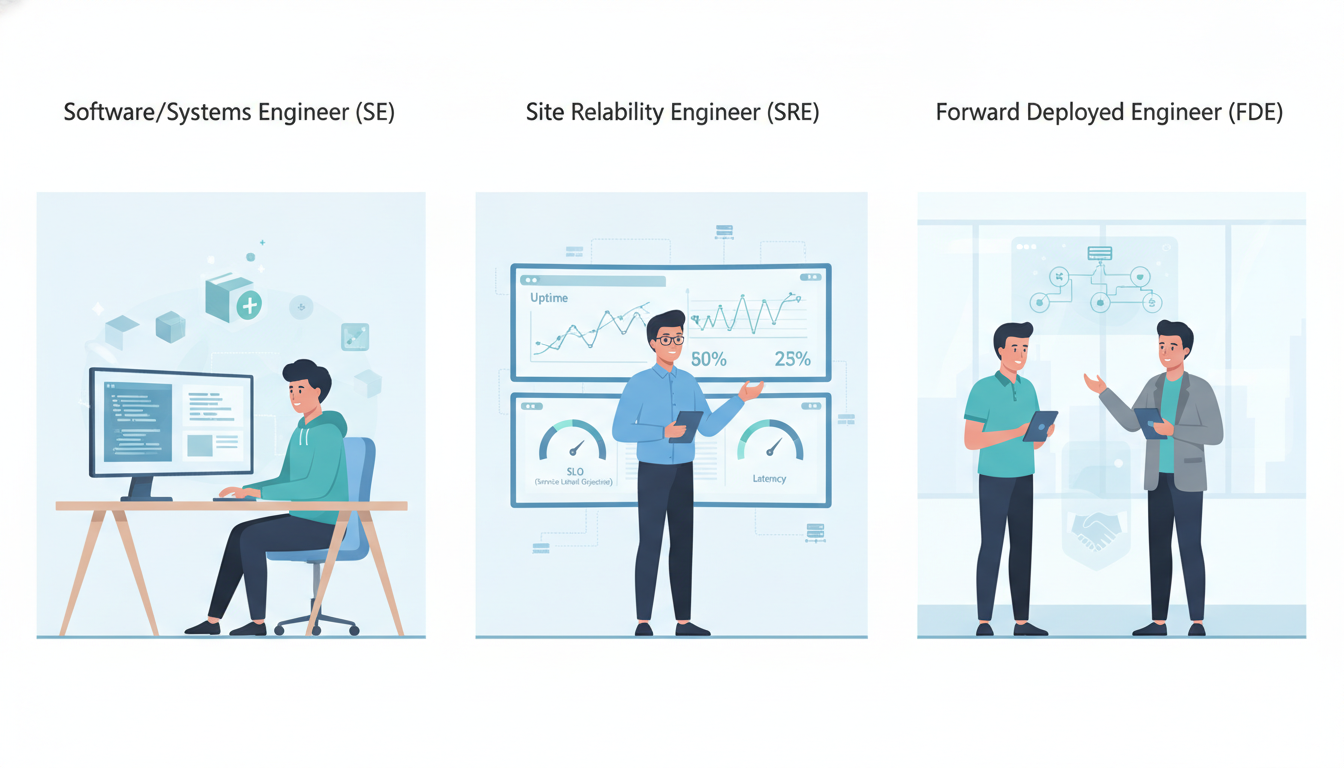
Job titles in the IT industry are riskier than they look.
They all carry the word "engineer," yet the actual work can be completely different. Software Engineer, Systems Engineer, Site Reliability Engineer, and Forward Deployed Engineer are all engineers, but they differ in how they frame problems and what counts as success.
The abbreviation "SE" in particular shifts meaning by country and industry. In the Korean and Japanese SI (System Integration) industries, SE often means Systems Engineer, and in Korea it is sometimes short for Server Engineer. In the job postings of global IT companies, however, SE usually leans toward Software Engineer.
So anyone choosing a career should look beyond the title alone and ask what the role actually builds, what it is accountable for, and what kind of person it suits.
This article compares SE, SRE, and FDE — from etymology to responsibilities, temperament, and learning direction.
1. The Etymology and Meaning of SE
SE is the most confusing of the three.
It is generally used in three senses.
First, Software Engineer.
This is the most common meaning in the global IT industry. It refers to an engineer who designs and implements software. People who build web services, mobile apps, backend APIs, data processing systems, and SaaS products fall into this category.
Second, Systems Engineer.
In the Korean and Japanese SI industries, SE has long been used as an abbreviation for Systems Engineer. In this case, SE is less a plain programmer and closer to a broad systems engineer whose scope includes requirements analysis, basic design, detailed design, customer coordination, testing, and part of project management.
Third, Server Engineer.
In Korea, Server Engineer is sometimes shortened to SE in the field. But this is hardly a globally standardized abbreviation. It is merely a case of internally calling infrastructure engineers — those handling Linux, Windows Server, virtualization, storage, network, and middleware operations — SE.
So when someone says "I want to become an SE," you must first ask:
Do you mean Software Engineer, Systems Engineer, or Server Engineer?
Without this distinction, everything from role selection to learning direction can go wrong.
2. The Etymology and Meaning of SRE
SRE stands for Site Reliability Engineering.
Literally, "site reliability engineering." Here, "site" does not mean just a website. It is more accurate to read it as the entire large-scale service, platform, and system that users rely on.
SRE became widely known through Google. Google's SRE book explains that SRE teams have been involved in how Google's large-scale software systems are built, deployed, monitored, and maintained. In other words, SRE is not merely an operations team but a role that solves operational problems with a software-engineering approach.
The core question of SRE is this:
Is this service being operated reliably at the level users expect?
If a Software Engineer builds features, an SRE makes sure those features are delivered reliably in an actual production environment.
Key concepts here are SLA, SLO, SLI, and Error Budget.
SLA (Service Level Agreement) is a promise to the customer. For example, "we guarantee 99.9% service availability" can be an SLA — a contractual commitment.
SLO (Service Level Objective) is the service-level target you aim to achieve internally. For example, "99.95% of API requests must respond normally over the last 30 days" is an SLO.
SLI (Service Level Indicator) is the actual measured metric. Values such as success rate, latency, error rate, and availability become SLIs.
Error Budget is the amount of failure you can tolerate. Google's SRE Workbook describes the Error Budget as "1 - SLO." For example, with a 99.9% SLO, the Error Budget is 0.1%. If there are 1,000,000 requests over four weeks, a 99.9% availability SLO gives you a budget of 1,000 errors.
The strength of SRE is not "we will drive failures to absolute zero." It is setting a realistic reliability target and managing the balance between development speed and operational stability within that range. Google's SRE Workbook also explains that product managers, development teams, and SREs must agree on the SLO and the Error Budget Policy. When the Error Budget is exhausted, measures such as halting releases and prioritizing reliability bugs can be set as policy.
3. The Etymology and Meaning of FDE
FDE stands for Forward Deployed Engineer.
Literally, roughly "an engineer deployed to the front." It sounds like military jargon, but in the tech industry it refers to an engineer stationed close to the customer's site to solve real problems.
This concept became widely known through Palantir's Forward Deployed Software Engineer (FDSE) model. According to Palantir, an FDSE is a software engineer who works directly with customers to configure Palantir's existing software platform to solve the customer's difficult problems. Whereas a traditional software engineer focuses on building a single feature that many customers will use, an FDSE focuses on enabling many features and workflows for a single customer.
Recently, the FDE role has been actively appearing at AI companies as well. OpenAI's Forward Deployed Engineer posting explains that an FDE deploys frontier models into production end-to-end together with strategic customers, taking responsibility for discovery, technical scoping, system design, build, and production rollout. It also states that they collaborate directly with the customer's engineering teams and domain teams.
OpenAI's Tokyo FDE posting is in the same vein. The FDE works at the intersection of customer deployment — turning research outcomes into production systems — and core platform development, and is responsible for technical delivery from the first prototype to stable production. The role also includes going deep into customer teams to understand their needs, contributing code directly when necessary, and organizing repeatable patterns into tools and playbooks.
So an FDE is neither plain technical support nor a pure consultant.
An FDE is an engineer who directly designs, builds, integrates, deploys, and embeds a product so that it works inside the customer's real environment.
4. The Core Differences Between the Three Roles
Summarized in one sentence each:
SE builds the features of a product or system.
SRE makes that product or system run reliably.
FDE makes that product or system deliver results in the customer's real environment.
It is even clearer in a table.
| Category | SE | SRE | FDE |
|---|---|---|---|
| Typical meaning | Software Engineer / Systems Engineer | Site Reliability Engineer | Forward Deployed Engineer |
| Core goal | Feature implementation and product development | Reliability, availability, operational automation | Adoption in the customer environment and delivering results |
| Main question | What should we build? | How do we operate it reliably? | How do we make it work at the customer's site? |
| Main targets | Products, features, codebase | Operational systems, infrastructure, service quality | Customer work, customer data, customer systems |
| Success criteria | Feature launch, quality, maintainability | Meeting SLOs, reducing incidents, improving MTTR | Production adoption, business impact, solving the customer's problem |
| Where they work | Inside the product development team | Platform/operations/infrastructure organization | Between the customer and the product team |
| Required skills | Development, design, algorithms, testing | Automation, monitoring, incident analysis, infrastructure | Development, integration, communication, domain understanding |
| Dangerous misconception | SE = necessarily a server engineer | SRE = a mere operator | FDE = technical support or sales |
5. How Do the Three Roles Differ on the Same Project?
Suppose you are building an enterprise AI document search system.
The SE builds the features of the search system.
- Document upload API
- Search API
- User permission management
- Admin screen
- Vector search logic
- Backend services
- Frontend UI
The SE's concern is: "Does the product function well?"
The SRE makes that system run reliably.
- Kubernetes deployment
- CI/CD pipeline
- Log and metric collection
- Incident alerting
- Automatic recovery
- Capacity planning
- Database performance management
- Post-incident postmortems
- SLO and Error Budget management
The SRE's concern is: "Is the search system delivered reliably in a real production environment?"
The FDE makes this system deliver real business results in the customer's environment.
- Analyzing the customer's document structure
- Integrating with existing in-house systems
- Mapping the permission scheme
- Designing search UX that fits the customer's business processes
- Solving the customer's data quality problems
- Turning a PoC into production
- Writing integration code together with the customer's engineers
- Feeding requirements discovered in the field back to the product team
- Turning repeatable implementation patterns into playbooks
The FDE's concern is: "Is this customer actually using this system to solve their business problems?"
6. Who Is Suited to Be an SE?
SE suits people who take great joy in building products.
You should be interested in the very process of designing new features, writing code, improving structure, and crafting performant logic.
Traits that suit an SE:
- Enjoys digging deep into code.
- Cares a lot about abstraction, design, and structuring.
- Enjoys steadily improving one product or codebase.
- Interested in turning clear requirements into an implementable structure.
- Feels rewarded by implementing user experience or business features with technology.
Conversely, if you strongly dislike frequent customer meetings, on-site variables, unclear requirements, and operational incident response, SE may be more comfortable than FDE or SRE.
What an SE should learn:
- Data structures and algorithms
- At least one programming language
- Object-oriented / functional design principles
- Database fundamentals
- HTTP, API design
- Test code
- Git and collaboration practices
- Cloud and container basics
- Security fundamentals
- Performance optimization basics
A backend SE should go deeper into DB, transactions, caching, message queues, and distributed systems. A frontend SE should go deeper into browsers, rendering, state management, accessibility, and UX quality.
7. Who Is Suited to Be an SRE?
SRE suits people who, rather than fearing failures, find interest in analyzing them and reducing them systematically.
An SRE should think less about "why did it die?" and more about "how do we automatically detect and recover next time?"
Traits that suit an SRE:
- Enjoys seeing the whole system flow.
- Enjoys root-cause analysis of failures.
- Wants to automate repetitive work.
- Interested in finding performance bottlenecks.
- Loves observability data such as metrics, logs, and traces.
- Can weigh the balance between stability and speed.
- Sees operational responsibility not merely as a burden but as an engineering problem.
Conversely, if you strongly dislike the pressure of production incidents, on-call, uncertain failure situations, and the compound problems of infrastructure and networking, SRE can be exhausting.
What an SRE should learn:
- Linux
- Networking basics
- Operating systems and processes/memory/filesystems
- Cloud infrastructure
- Kubernetes
- IaC such as Terraform
- CI/CD
- Monitoring and alerting design
- Logs/metrics/tracing
- Incident response and postmortems
- SLI/SLO/Error Budget
- Performance analysis
- Security and access management
- Scripting or systems programming
An SRE is not an operator who doesn't know code. On the contrary, because operational problems must be solved with code, the ability to write tools in Python, Go, or Bash matters.
8. Who Is Suited to Be an FDE?
For an FDE, loving technology alone is not enough, and loving customers alone is not enough either.
An FDE must listen to the customer's ill-defined problems and, within them, build a technical solution that actually works. There may be no documented requirements, the customer's data may be messy, and existing systems may impose many constraints. Even so, you must produce results.
Traits that suit an FDE:
- Does not find talking directly with customers burdensome.
- Strong at structuring ill-defined problems.
- Can build quick prototypes.
- Values a result that is actually used over a perfect product.
- Interested in moving back and forth between technology and business.
- Can rapidly learn new domains.
- Strong with field variables and exceptional situations.
- Can coordinate among the product team, customer, sales, security, and operations.
Conversely, if you prefer only an environment where you quietly write deep code alone, or you strongly dislike the customer's frequent change requests, FDE may not fit.
What an FDE should learn:
- Software development fundamentals
- API integration
- Data modeling
- SQL and data pipelines
- Cloud basics
- Authentication/authorization/security
- System architecture
- Rapid prototyping
- Customer requirements analysis
- Technical writing
- Presentation and communication
- The ability to learn domain knowledge
- In the AI era: LLM APIs, RAG, Agents, Evaluation, MCP, and security/governance
An FDE is close to "a developer who stands in front of the customer." Not someone who merely explains but who must actually build, and not someone who merely builds but who must make it usable by the customer.
9. From a Career-Choice Perspective
You cannot say one role is simply better.
Each role solves a different kind of problem.
If you want to go deep into code and the product itself, SE is good.
If you want to make a service run reliably at large scale, SRE is good.
If you want to solve the complex problems of the customer's site with technology and see the product turn into real business results, FDE is good.
That said, in the early stages of a career, building a solid SE foundation is advantageous. SREs must also understand code, and FDEs must also build things directly. If you move to SRE or FDE with weak software development fundamentals, you risk being stuck at tool usage or customer handling rather than solving problems deeply.
A recommended path:
First, build development fundamentals.
Master one language properly and experience APIs, DB, Git, testing, and deployment.
Second, understand the operational environment.
Experience Linux, networking, cloud, logs, monitoring, and incident response.
Third, look at your own temperament.
If you want to keep living in product code, deepen into SE. If failures and operational automation are fun, expand into SRE. If solving the customer's site and business problems is fun, broaden into FDE.
10. Problems That Arise from Misunderstanding the Three Roles
If you understand SE only as Server Engineer, misunderstandings arise in the global job market. Overseas postings for SE are most likely Software Engineer. Conversely, SE in Korean SI postings may be Systems Engineer. You must always check the job description.
If you understand SRE only as an operations team, you miss the point. An SRE is not someone who manages servers by hand but someone who designs and automates reliability in software.
If you understand FDE only as technical support, you shrink the role. An FDE is not a support organization handling customer inquiries but an engineer who builds production-grade results in the customer's environment and connects that back to product improvement.
11. Final Summary
SE, SRE, and FDE are all important roles in a modern IT organization.
But each has a different center.
SE builds the product.
SRE makes the product run reliably.
FDE makes the product deliver real results at the customer's site.
When choosing a technical career, what matters is not chasing a trendy job title. It is knowing which kind of problem absorbs you the most.
If you are absorbed in building features through code, SE.
If you are absorbed in reducing failures and stabilizing systems, SRE.
If you are absorbed in solving the customer's complex, real-world problems with technology, FDE.
Seen this way, the three roles are not competitors but three axes needed for a single product to succeed.
A good product is built by SE, a trusted service is protected by SRE, and real customer results are completed in the field by FDE.


Comments
Post a Comment