The Convergence of AI and Space Tech: Key 2026 Space Innovation Trends and Insights from Google Trends
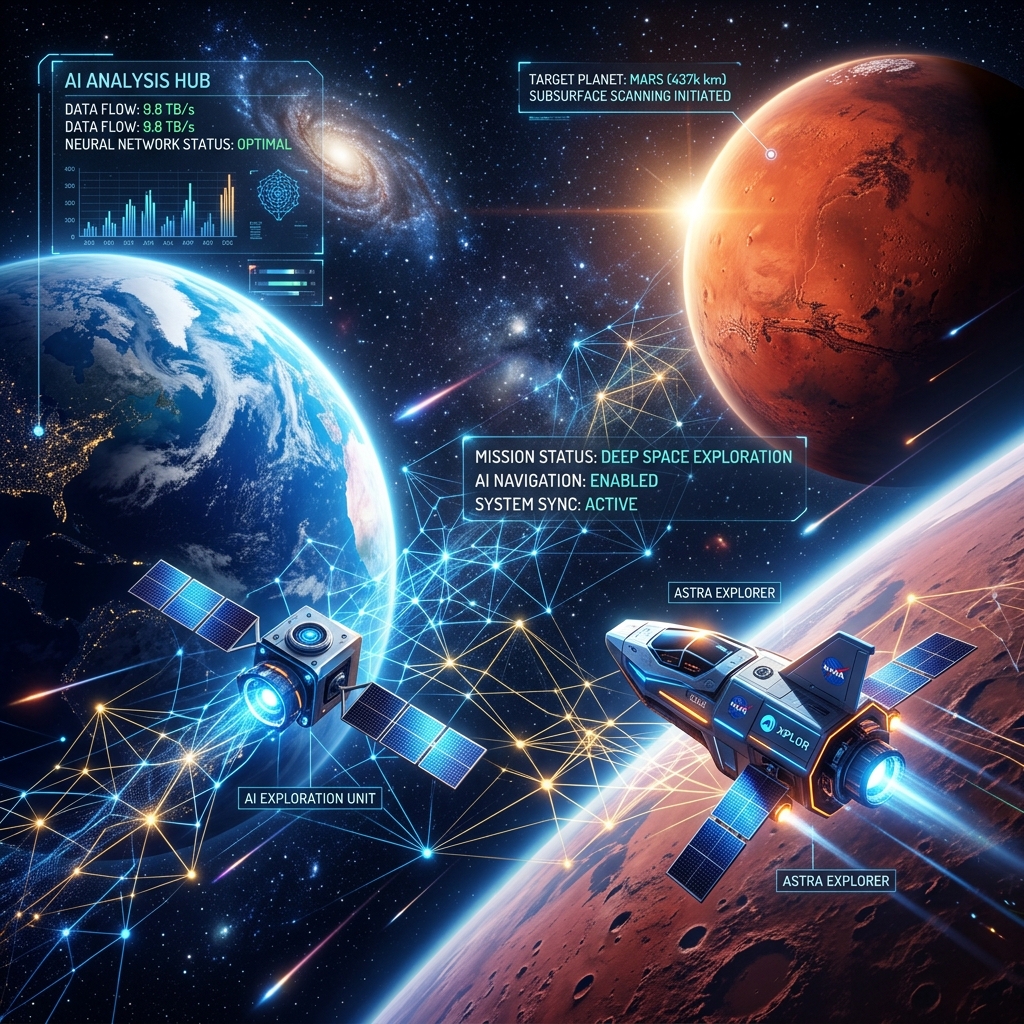
The intersection of Space Exploration, humanity's ultimate frontier, and Artificial Intelligence (AI), the pinnacle of modern technology, is driving unprecedented innovation. According to 2026 Google Trends and industry reports, AI has transitioned from an experimental tool into a critical, foundational infrastructure for space operations.
In this post, we examine four key trends shaping the space-AI ecosystem and analyze the strategic insights they offer for the future of technology.
1. The Rise of Edge AI and Orbital Data Centers
Historically, space probes and satellites had to transmit all raw data back to Earth to be processed by ground stations. However, limited downlink bandwidth and high latency between Earth and outer space have always been major bottlenecks for real-time decision-making.
In 2026, the most promising solution is the convergence of Edge AI and Orbital Data Centers.
- Onboard Processing: Equipping satellites with high-performance AI chips allows them to analyze data in orbit in real-time. For instance, earth observation satellites can filter out useless, cloud-covered imagery on the spot, compressing and transmitting only valuable data, which drastically reduces downlink costs.
- Real-time Disaster Response: In emergencies like wildfires, floods, or hurricanes, orbital Edge AI can immediately identify affected areas and send instant alerts to ground rescue teams.
2. Satellite Constellation Automation and Collision Avoidance
With the rise of "Mega-Constellations"—where thousands of satellites orbit Earth in tight clusters—Earth's orbit has become more congested than ever. Manually calculating and executing orbital maneuvers for each individual satellite is practically impossible.
- Autonomous Collision Avoidance: Modern constellations, such as SpaceX's Starlink, utilize AI algorithms to monitor potential orbital collision risks and automatically execute avoidance maneuvers without ground intervention.
- Maximizing Operational Efficiency: Thanks to AI, mega-constellations that once required dozens of engineers can now be managed by a minimal staff, significantly reducing ground-segment operational costs.
3. AI-Driven Space Situational Awareness (SSA) and Debris Management
With the exponential growth of active satellites, space debris—the remnants of defunct spacecraft—presents a major threat to the orbital ecosystem. To address this, AI is being heavily integrated into Space Situational Awareness (SSA).
- Precision Orbit Prediction: Machine learning models track and predict the irregular trajectories of hundreds of thousands of space debris fragments with high accuracy.
- Supporting Debris Removal Missions: When active debris removal satellites attempt to capture rotating debris, real-time 3D computer vision AI analyzes the target's rotation and movement to calculate safe capture paths.
4. NASA's Autonomous Rovers and Deep Space Navigation
For planetary exploration on Mars and beyond, one-way communication takes several minutes, making real-time remote control from Earth impossible.
- Smart Drive: NASA's Perseverance rover leverages onboard AI to detect hazards and dynamically navigate the rugged Martian terrain autonomously in real-time.
- Deep Space Autonomy: Autonomous AI navigation is laying the groundwork for humanity's journey beyond the Moon, allowing deep-space spacecraft to self-locate and adjust their trajectories autonomously.
📊 Space AI Market Outlook
| Metric | 2025 Baseline | 2026–2035 Outlook |
|---|---|---|
| Market Role | Experimental integration | Established core operational infrastructure |
| Primary Drivers | Autonomous navigation, constellation scaling | Deep space exploration, on-orbit servicing |
| Key Challenges | Orbital congestion, cyber threats | Global regulations, edge hardware optimization |
💡 Technical Insights for Developers and Engineers
The growth of the Space AI sector opens up new horizons for software engineers on Earth:
- Embedded & Edge Computing: The demand is rising for lightweight machine learning models (TinyML) that operate efficiently under extreme constraints of power and hardware (e.g., radiation-hardened chips).
- Real-time Data Pipelines: Distributed systems that can process and analyze massive streams of real-time time-series telemetry data from thousands of satellites are highly sought after.
- The Rise of Rust and C++: Due to the zero-tolerance policy for memory errors in space, Rust is steadily trending upward alongside C++ on Google Trends for space-grade software development.
Conclusion: AI, the New Compass for Space Exploration
AI is no longer just a tool for processing data; it has become an indispensable compass and pilot for humanity's journey into the vast cosmos. As the integration of AI and space tech advances, it will first revolutionize everyday services like communications, weather forecasting, and disaster recovery. Ultimately, it will serve as the cornerstone for establishing sustainable human habitats on the Moon and Mars.


Comments
Post a Comment