AI Developer Alternatives Compared: From Coding to DevOps and Production Operations with GIIP FDE Box
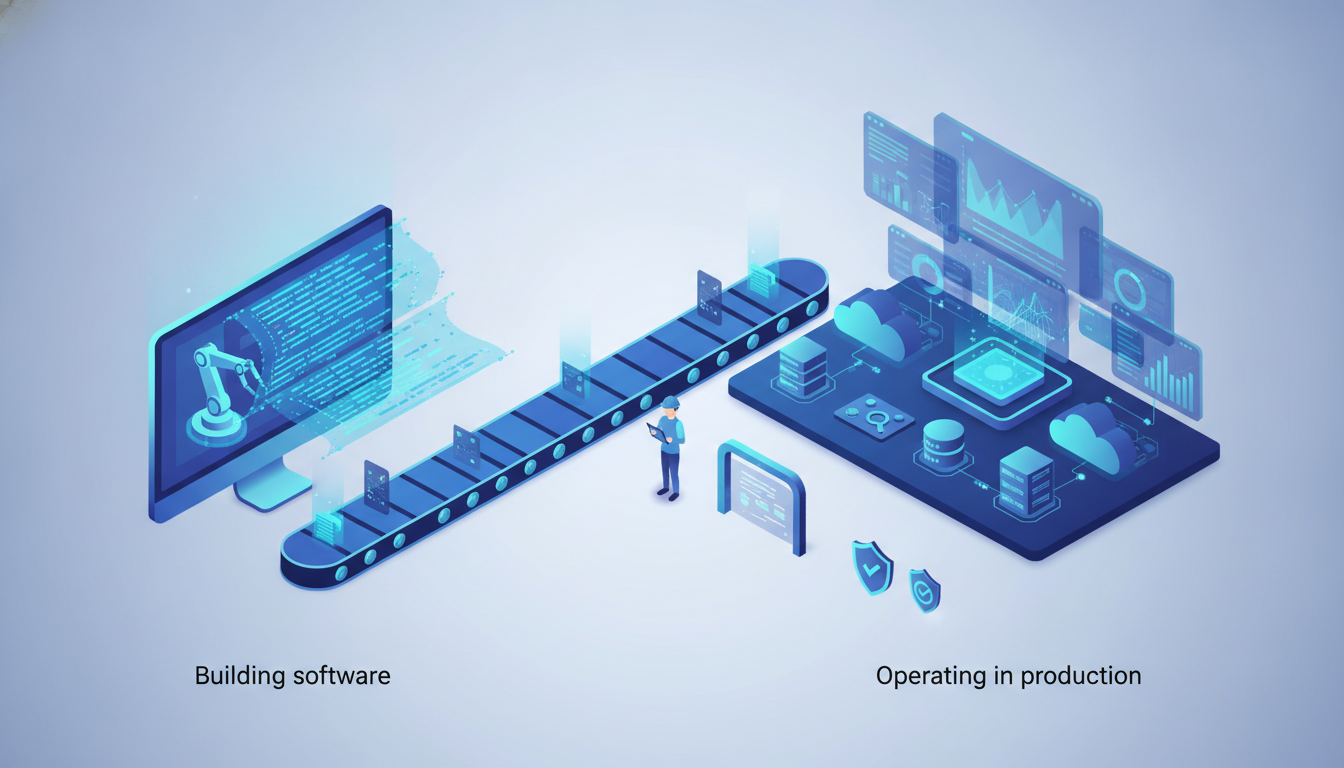
When you talk to startup founders or SES (staffing) sales reps these days, you hear similar questions.
"Can't we build the service with AI instead of hiring more developers?" "We're short on engineers to staff a client project — can't AI take their place?" "They say AI writes the code, so is there a way to cut operations headcount too?"
General-purpose AI like ChatGPT, Claude, and Gemini handles everyday office work — writing documents, research, summarizing meetings — quickly. AI coding agents like Cursor, Claude Code, GitHub Copilot, and Devin analyze source code, implement features, and even run tests and open pull requests.
But what companies actually need is not merely an AI that writes code.
To build a service that customers will pay to use, a lot of work is still required after development.
- Building dev, staging, and production environments
- Configuring databases and networks
- Applying WAF, CDN, load balancers, and security policies
- CI/CD and production deployment
- Monitoring and incident response
- Performance tuning and cloud cost optimization
- Managing approval records, change history, and rollbacks
This is exactly where AI coding tools and an AI development-and-operations automation platform part ways.
AI development-automation competitors already exist
It's not that there are no services comparable to GIIP. The market simply splits into roughly three categories.
1. AI coding agents
Representative examples include GitHub Copilot, Claude Code, Cursor, and Devin.
They are strong at analyzing an existing repository, editing code, running tests, and creating pull requests. Comparative studies of AI coding agents likewise show Codex, Copilot, Devin, Cursor, and Claude Code being used across different tasks — feature development, bug fixing, documentation. Yet no single agent was best at every type of task, and the final merge and responsibility mostly stayed with humans.
Devin edits source code in a dedicated workspace and can connect to a company's internal development environment. It even offers Outposts, which runs commands on its own VM, container, or Kubernetes environment. But its central role is, above all, performing software-engineering work.
In other words, AI coding agents can boost developer productivity or take over some development work, but their scope differs from a service that automatically owns a company's entire infrastructure and production operations.
2. AI app-building and deployment platforms
There are also services like Replit Agent that build an application from natural language and publish it right away.
Replit Agent plans and builds an app from the user's idea and can ship it in the Replit environment via static deployment, autoscaling, or a dedicated VM.
This approach is effective for quickly producing MVPs, internal tools, landing pages, or relatively standardized web services.
But things get complicated once requirements like these are involved:
- Integration with existing AWS, Azure, or GCP accounts
- Operating different infrastructure across multiple client companies
- Connecting to internal networks, legacy systems, and databases
- Country-specific data-residency policies
- Complex network and security configurations
- Incident analysis for services already in production
- Database performance tuning
- Continuous cost optimization
Being able to "publish an app" and being able to "continuously operate" a company's production systems are not the same thing.
3. DevOps and platform-engineering automation
GIIP's closest competitors are DevOps and platform-engineering products such as DuploCloud, Qovery, and Humanitec.
DuploCloud positions itself as an AI DevOps platform that automates infrastructure provisioning, CI/CD, security, compliance, and operations. It also offers a human-in-the-loop AI DevOps Engineer, making it one of the most direct competitors to GIIP.
Qovery provides an Agentic Infrastructure Platform that unifies CI/CD, Kubernetes, Terraform, secrets, and monitoring behind a single API so AI agents can operate the infrastructure directly.
Humanitec's strength is its Platform Orchestrator, which connects a company's Terraform or OpenTofu modules and provisions infrastructure according to standard policies. It lets developers use environments in a standardized way without touching infrastructure directly.
So saying "there are no competitors for development and operations automation" is inaccurate. Overseas, there are already quite powerful DevOps-automation and infrastructure-orchestration platforms.
That said, these products are mostly tools for companies that already have development teams and platform-engineering organizations to standardize infrastructure operations.
So what makes GIIP FDE Box different?
The heart of GIIP is not offering a single coding tool or a single DevOps product.
The execution flow presented on GIIP's website looks like this:
- Requirements analysis
- UI and API development
- Saving to GitHub
- Building Dev, Staging, and Production environments
- Configuring database, WAF, and CDN
- Testing
- Approval
- Production deployment
- Monitoring and incident response
- Performance and cost optimization
In other words, GIIP FDE Ops is positioned to take a business requirement as input, produce a development deliverable, and connect it all the way through to running as a real production service.
Where a general AI coding tool supports a developer's work, GIIP tries to connect the work once handled by development teams, DevOps, SREs, DBAs, and cloud operators into a single operating process.
Competitor comparison
| Category | Key services | Code dev | App deploy | Customer cloud infra | Continuous ops & incidents | Performance & cost | Delivery model |
|---|---|---|---|---|---|---|---|
| General office AI | ChatGPT, Claude, Gemini | Assist | Limited | Limited | Limited | Limited | Consumer/enterprise AI |
| AI coding agents | Copilot, Cursor, Devin, Claude Code | Strong | Partial | Tool-integration focused | Limited | Limited | Developer tools |
| AI app-building platforms | Replit Agent, etc. | Strong | Strong | Own-platform focused | Within platform scope | Within platform scope | SaaS build environment |
| Platform orchestration | Humanitec | Not direct dev | Strong | Strong | Standardization/orchestration | Some | For platform engineers |
| Agentic Infrastructure | Qovery | Not direct dev | Strong | Strong | Infra-ops focused | Supported | Infrastructure platform |
| AI DevOps | DuploCloud | Not direct dev | Strong | Strong | Strong | Supported | DevOps automation platform |
| GIIP FDE Box | GIIP FDE Ops | From requirements to dev | Dev/Stg/Prod build | Incl. DB, network, security | Monitoring & incident response | Through performance & cost | AI execution + FDE experts |
What matters in this table is not the sheer number of features.
GIIP's real competition is not OA-automation services like ChatGPT or Microsoft 365 Copilot, but the combination of an "AI developer" like Devin, an app-building platform like Replit, and DevOps-automation platforms like DuploCloud, Qovery, and Humanitec.
Why a startup founder needs GIIP
When a startup adopts AI development tools, initial development speed can indeed increase.
But building code faster does not make business risk disappear. If anything, the faster you develop, the faster unreviewed code, throwaway infrastructure, excessive cloud costs, and operational debt can pile up.
What a startup founder actually needs is a system that can answer these questions:
- Is it safe to deploy this code to production?
- Where is personal information and customer data stored?
- When an incident happens, who detects and recovers it?
- Does it scale automatically when users increase?
- Who controls it when cloud costs exceed the expected range?
- If AI executes a wrong change, can it be rolled back?
GIIP is not a structure that hands every task to AI unconditionally. It automates state collection, analysis, testing, execution of approved runbooks, and monitoring — while requiring prior approval for high-risk actions such as production deployment, data deletion, and permission/firewall changes. Judging new incidents and making architecture decisions are separated out to be handled by experts.
For a startup, this is more realistic than the exaggerated promise that "AI will completely replace developers."
That's because it is a structure where AI handles repetitive work and execution volume, while humans stay in control of the important judgments and responsibility.
Why an SES sales rep needs GIIP
The biggest problem in SES sales is that even after winning a project, it's hard to secure the right engineer at the right time.
And securing one developer isn't the end of it. Depending on the project, you additionally need:
- Frontend developers
- Backend developers
- Cloud engineers
- DevOps or SREs
- Database engineers
- Security specialists
- Project managers
The bigger problem comes after you introduce someone.
If their skill level doesn't match the client's expectations, or the assigned person quits, or the handover isn't done properly, the SES sales rep has to keep mediating problems between the client and the engineer.
GIIP FDE Box is not a way to introduce one particular developer.
It accumulates work requests, development, testing, deployment, and operations records inside the platform, and AI and FDE experts use the same operating structure. This reduces the risk of knowledge and permissions concentrating in one individual, and lets you propose to clients a sustainable development-and-operations system rather than an individual.
This does not mean SES companies must abandon their existing staffing business right away.
A hybrid model is realistic: automate repetitive development, testing, environment setup, monitoring, and reporting with the FDE Box, while assigning skilled engineers to client communication, design judgment, and high-risk work.
As a result, SES sales can change their pitch from:
"We'll send you one developer."
to
"We'll provide an AI development-and-operations environment together with the FDE experts who control it."
When you should recommend GIIP
GIIP is not a service every company unconditionally needs.
If developers just want to boost their own productivity while coding themselves, Cursor, Claude Code, or GitHub Copilot are simpler.
If you want to turn an idea into an MVP quickly and publish it on a hosted platform, a service like Replit may be a good fit.
If you already have a large platform-engineering organization and want to standardize Kubernetes and Terraform, you might look at Humanitec, Qovery, or DuploCloud first.
On the other hand, there is a clear reason to consider GIIP if you match these conditions:
- A startup that needs to build and validate a product before hiring developers
- A company with no one to operate a service after outsourced development
- An SMB that finds it hard to separately hire DevOps, SREs, or DBAs
- A company that splits development and infrastructure operations across multiple vendors
- An SES firm that can win projects but struggles to secure engineers
- A company that must operate legacy systems together with cloud and databases
- A company that needs AI to execute but also needs approval, audit trails, and rollback
- A company that needs a partner to handle incident response and cost optimization after launch
Conclusion: what companies need is not an "AI developer" but an "AI development-and-operations team"
The AI coding agents of 2026 are quite powerful. Even in real enterprise environments, they are used for feature development, bug fixing, testing, and pull-request creation. Yet studies show the final approval and merge authority mostly remains with humans.
This does not mean AI is useless.
It means it has become more important to decide what to let AI execute, at which point to require human approval, and how to monitor and recover from the results of that execution.
That is precisely why GIIP FDE Box is worth recommending.
GIIP is not merely an AI that generates code. It aims to turn requirements into development deliverables, deploy those deliverables to Dev/Staging/Production environments, and provide the operating layer that continues through database, network, security, monitoring, incident response, performance improvement, and cost optimization.
If you're looking for an AI to replace one developer, there are many options.
But if you're a startup or SES company that wants to close the gap between the development team and the operations team, comparing AI coding tools alone is not enough.
What you should compare is not "which AI writes code best," but this question:
Who will bring this service to a state real customers can use — and keep operating it after launch?
GIIP FDE Box is a service built to answer exactly that question.


Comments
Post a Comment