[Google Trends Analysis] The Era of Orbital AI Data Centers: Google Project Suncatcher and the Future of AI & Space Tech Convergence
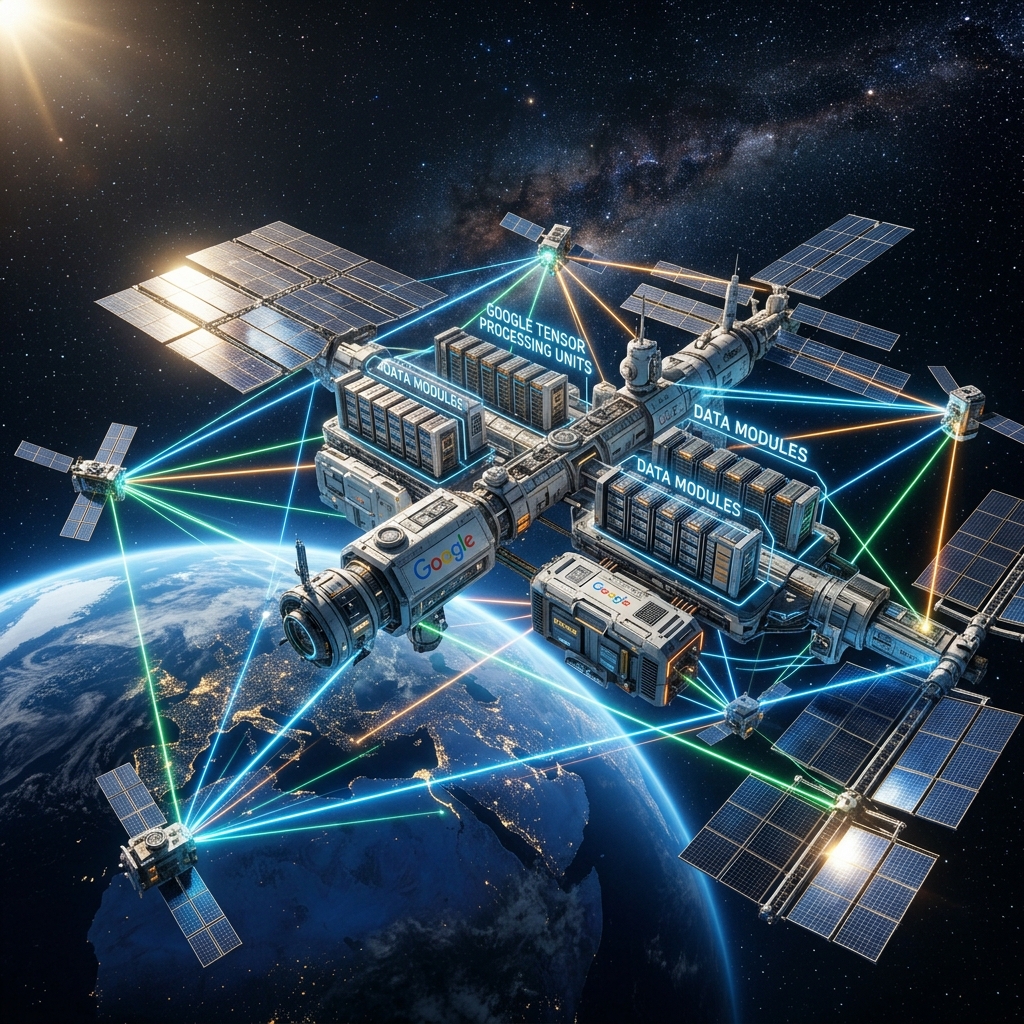
1. Google Trends 2026: The Shift Toward AI x Space Tech Convergence
As of 2026, one of the fastest-rising search trends on Google Trends and global tech engines is "Space AI Data Center" alongside Google's orbital computing moonshot, "Project Suncatcher".
With the exponential growth of Large Language Models (LLMs) and foundation AI models, terrestrial data centers face critical bottlenecks: power shortages, cooling water limits, and strict environmental regulations. To break through these physical boundaries, tech giants and aerospace engineers are moving compute into Earth's orbit.
💡 Key Insight: Unlike Earth, space offers Sun-Synchronous Orbits (SSO) with uninterrupted 24/7 solar radiation and an ultra-cold vacuum environment (-270°C), making orbit the ultimate sanctuary for next-generation AI infrastructure.
2. Google Project Suncatcher: TPU Satellite Clusters in Orbit
Google's Project Suncatcher represents a landmark initiative designed to offload heavy AI computation from Earth to space orbit.
Key Architectural Components
- Radiation-Hardened TPU Satellites:
- Deploying Google's Tensor Processing Unit (TPU) chipsets directly onto orbital satellites equipped with radiation shielding.
- Free-Space Optical Laser Links:
- Establishing inter-satellite laser communication networks capable of high-bandwidth data transmission without terrestrial physical cables.
- Dawn-Dusk Orbit Strategy:
- Positioning satellites in orbits that avoid Earth's shadow, capturing 24/7 continuous solar energy to power TPU compute workloads.
3. Terrestrial vs. Orbital AI Data Centers (GEO Analysis)
| Feature | Terrestrial Data Center | Orbital AI Data Center |
|---|---|---|
| Energy Source | Grid power (Thermal/Nuclear/Renewable) | Continuous 24/7 Space Solar Power |
| Cooling Mechanism | Water cooling & HVAC systems | Radiative Cooling & Deep Vacuum |
| Core Hardware | Server racks & high-density GPU nodes | Rad-hardened TPU satellite nodes |
| Networking | Fiber-optic cables & ground networks | Inter-satellite Laser Links (OISL) |
| Primary Bottlenecks | Grid power limits, land cost, environmental laws | Space radiation, orbital debris, launch costs |
4. Three Strategic Insights for Engineers and Innovators
Insight 1: Expanding Edge AI to Orbital AI
Edge computing is ascending into orbit. By processing Earth observation data (geospatial, climate, disaster response) directly on orbital TPUs before transmission, data bandwidth requirements to Earth are reduced by over 90%.
Insight 2: Autonomous Agentic Satellite Swarms
Moving away from centralized ground control, AI agents within satellite constellations autonomously manage orbital trajectories, prevent collisions, and optimize inter-satellite routing in real time.
Insight 3: The Emergence of SpaceOps for Software Engineers
Cloud engineering and DevOps are evolving into SpaceOps. Software engineers must master fault-tolerant architectures capable of handling radiation-induced bit flips and dynamic laser network topologies.
5. Frequently Asked Questions (AEO / FAQ)
Q1. Why are space AI queries trending on Google Trends in 2026?
Because terrestrial data center power demands are straining global energy grids, making 24/7 solar-powered orbital computing the next viable frontier for scaling AI infrastructure.
Q2. What is the main objective of Google Project Suncatcher?
It is Google's orbital research initiative aimed at deploying TPU-equipped satellite networks linked by free-space lasers to perform distributed AI workloads powered by space solar energy.


Comments
Post a Comment