2026 AI and Space Tech Fusion: Insights from Google Trends on Orbital Edge Computing and Space Data Centers
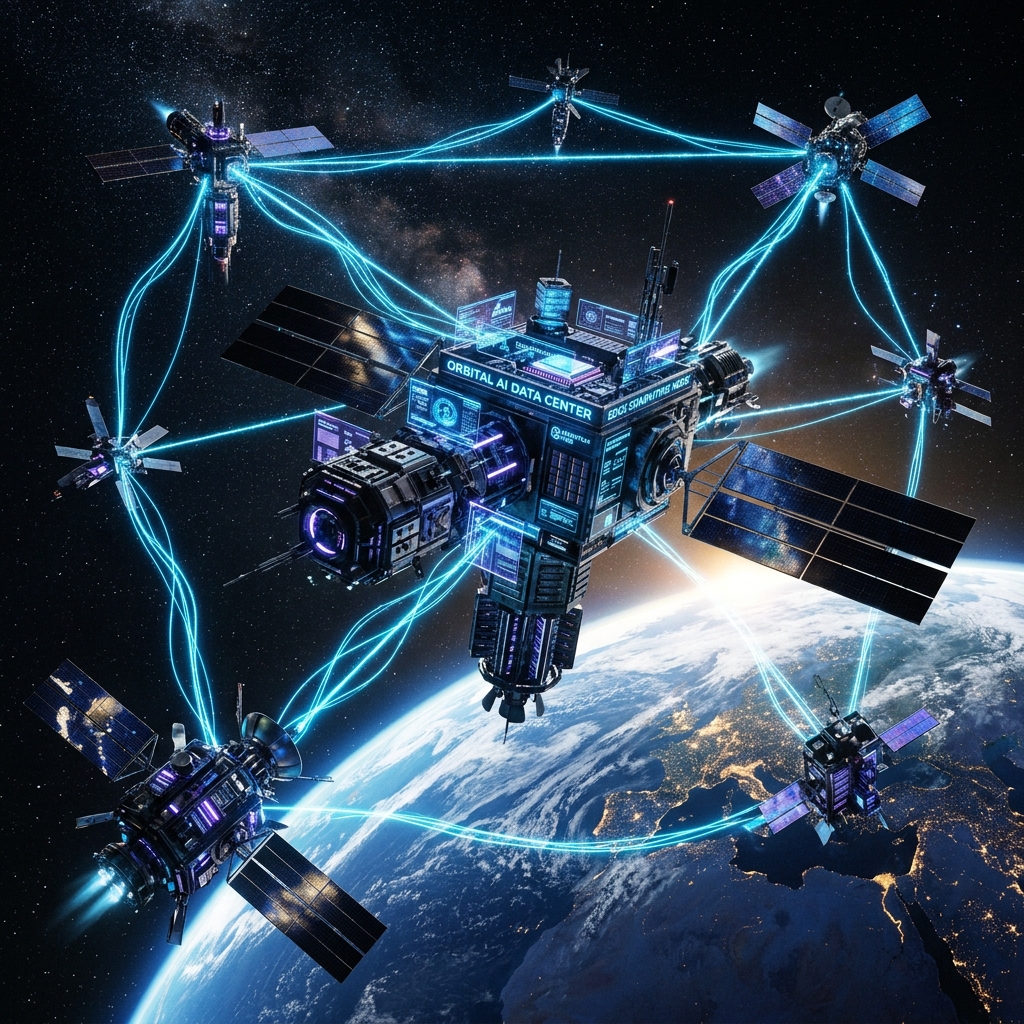
Overview: A Paradigm Shift in AI & Space Technology Revealed by Google Trends
In the global search trends of 2026, the most striking technological intersection is unequivocally the fusion of Artificial Intelligence (AI) and Space Technology. Historically, space exploration relied heavily on government-led telemetry transmission and ground-based computation. However, the surge in global AI workloads, the terrestrial energy wall, and communication latency constraints have elevated space into a primary frontier for computation and infrastructure.
According to Google Trends analysis, interest in topics like Orbital Edge Computing, Space AI Data Center, and Autonomous Spacecraft has experienced exponential growth year-over-year. This post highlights the critical trends and actionable insights defining the 2026 AI-space technology convergence for software engineers and technology strategists.
1. The Ascent of Orbital Edge Computing
Overcoming Legacy Satellite Bottlenecks
Conventionally, Earth observation satellites and deep-space probes beamed raw high-resolution imagery and telemetry to ground stations for centralized processing. This architecture suffered from severe limitations:
- Downlink Bandwidth Bottlenecks: Transmitting terabytes of satellite imagery down to Earth required hours or days.
- Lack of Real-time Response: Critical scenarios like wildfire detection, flood tracking, or orbital collision avoidance demand immediate decision-making.
The 2026 Reality: "Moving Results Is Cheaper Than Moving Raw Data"
In 2026, the space industry has shifted toward orbital edge computing. Satellites equipped with radiation-tolerant, ultra-low-power AI accelerators filter and analyze sensor data directly in orbit.
- Bandwidth Reduction: Transmitting only anomaly alerts or processed insights reduces ground downlink requirements by over 90%.
- Autonomous Maneuvers: Satellites detect space debris and autonomously perform collision-avoidance trajectory adjustments without ground-station commands.
2. Terrestrial Power Constraints & The Emergence of Space Data Centers
Breaking Through the Terrestrial 'Energy Wall'
With the explosion of large language models (LLMs) and spatial AI inference in 2026, ground-based data centers face severe grid power shortages. Global technology leaders are looking to Low Earth Orbit (LEO) as an alternative computing platform.
Why Space-Based Data Centers?
| Parameter | Terrestrial Data Center | Orbital Data Center (LEO) |
|---|---|---|
| Solar Power Efficiency | Limited by atmospheric absorption & day/night cycles (6-8 hrs/day) | Zero atmospheric loss, continuous 24/7 solar capture (up to 40x efficiency) |
| Cooling Mechanism | Heavy reliance on water & HVAC grid power | Radiative heat dissipation into vacuum & passive thermal radiators |
| Land & Grid Impact | High real estate costs & local power grid strain | Leverages orbital resources, minimizing terrestrial footprint |
Initiatives such as SpaceX's 'Starlink AI1' project and commercial LEO compute node trials demonstrate that deploying orbital data center infrastructure is an operational strategy for the next decade.
3. Autonomous Spacecraft & AI-Driven Constellations
Deep-Space Autonomy & Radiation-Hardened Chips
During deep-space missions to the Moon or Mars, round-trip communication delays can span minutes to hours. NASA and commercial space entities deploy autonomous spacecraft capable of self-directed navigation and hazard-avoidance landing.
- Real-Time Terrain Mapping: Fusing sensor feeds with deep learning algorithms enables precise, autonomous landings on unexplored planetary surfaces.
- Software-Defined Constellations: Satellite constellations form mesh network topologies to dynamically balance compute loads and reroute communication pathways.
4. 3 Strategic Insights for Tech Leaders and Developers
- Priority of Edge AI Optimization
- Expertise in on-device AI compression and low-power inference is now a core requirement for both mobile apps and orbital edge software.
- Distributed Compute & Mesh Architectures
- Understanding hybrid orbital-terrestrial cloud architectures will define competitive advantage in future distributed systems.
- Tracking Sustainable Tech Trends
- The trend toward space compute highlights growing ESG and energy challenges on Earth. Future infrastructure planning must account for ecological and energy footprints.
Conclusion
The 2026 convergence of AI and Space Technology is not science fiction—it is an industrial necessity driven by energy limitations and data processing demands. By paying close attention to orbital edge computing and space-based compute infrastructure, developers and tech leaders can position themselves at the forefront of the next technological frontier.


Comments
Post a Comment