2026 Google Trends Insights: The Convergence of AI and Space Tech — From On-Device Edge AI to Autonomous Swarm Robotics
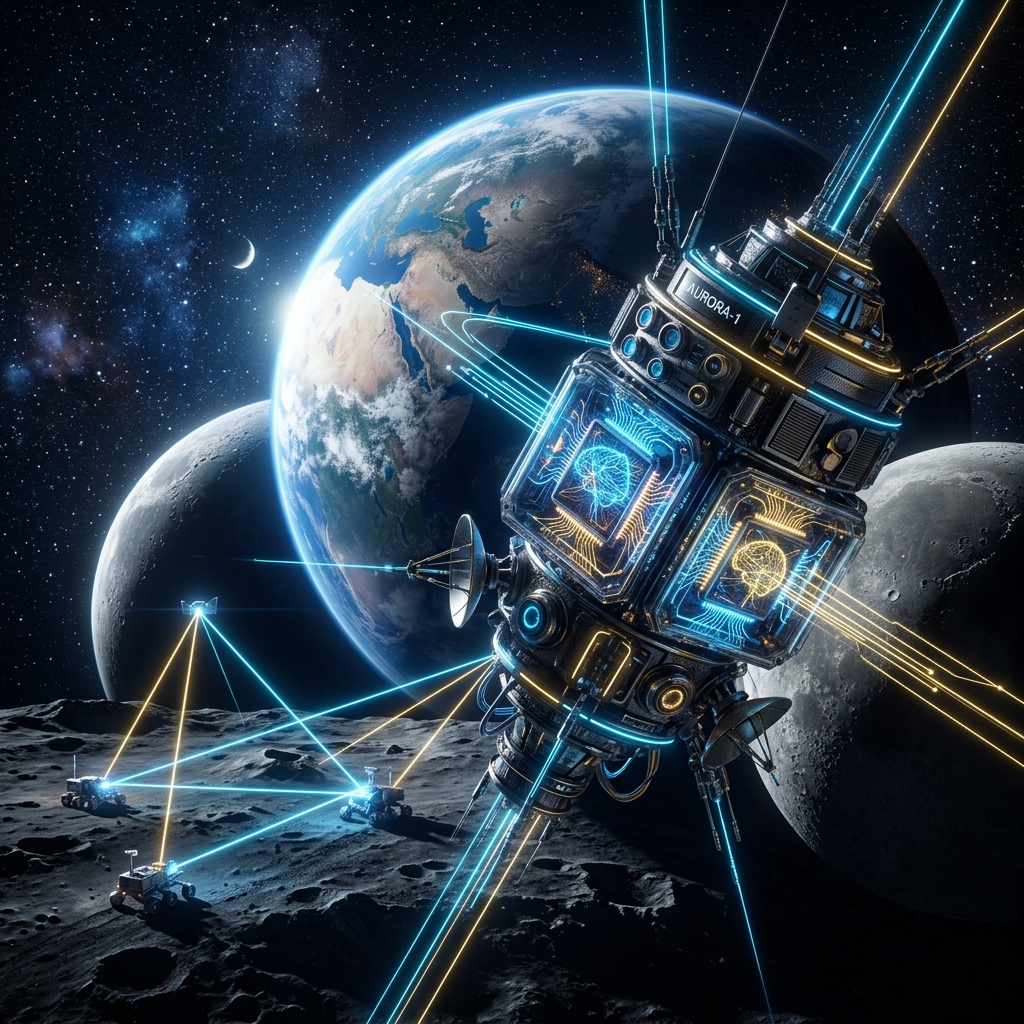
One of the most compelling topics in the 2026 technology landscape is the convergence of Artificial Intelligence (AI) and Space Technology. Analyzing recent Google Trends data reveals a dramatic global surge in search terms such as "Space AI," "Edge AI Satellite," "Autonomous Space Robotics," and "Orbital Data Center."
Moving far beyond executing AI algorithms solely on Earth, AI has now become the central "autonomous nervous system" for spacecraft and satellites. In this article, based on mid-2026 data and industry updates, we explore 3 pivotal trends driven by the combination of AI and space engineering, along with actionable insights for tech professionals and engineers.
1. Orbital Edge AI & In-Orbit Data Processing
Traditional satellite architectures relied on downlinking massive raw sensor and optical camera datasets to ground stations for processing on terrestrial supercomputers. However, with the exponential expansion of Low Earth Orbit (LEO) constellations, bandwidth constraints and downlink latency became critical operational bottlenecks.
The top trend highlighted by 2026 Google Trends is the widespread adoption of on-device Edge AI in orbit.
- Real-Time Space Data Filtering: Onboard NPUs and edge AI accelerators analyze imagery immediately after capture. Uninformative data (e.g., heavy cloud cover or static terrain) is filtered out in real time, transmitting only actionable event data—such as natural disasters, defense alerts, or environmental anomalies—to Earth.
- Autonomous Collision Avoidance & Anomaly Triage: In crowded LEO environments containing tens of thousands of active satellites and space debris, onboard Edge AI detects orbital collision risks in real time and controls thrusters without waiting for ground control commands.
- Google's Project Suncatcher: Initiatives placing TPU-based hardware into space orbits to utilize continuous solar energy and radiative cooling for large-scale ML training and inference are entering full-scale validation phases.
2. Autonomous Swarm Robotics and Lunar/Martian Exploration
The space exploration paradigm is shifting from monolithic, expensive rovers to collaborative multi-agent robotic swarms. This accounts for the high query volume around "autonomous robotic exploration" on Google Trends.
- NASA CADRE (Cooperative Autonomous Distributed Robotic Exploration): Teams of autonomous rovers deployed on the lunar surface elect leader nodes and map complex 3D lunar terrain through distributed task sharing—without real-time human intervention from Earth controllers.
- Starweave Architecture: Resilience is built into the distributed software layer. If an individual robot fails, the remaining swarm automatically redistributes mission objectives to maintain operational continuity.
- In-Situ Resource Utilization (ISRU): Swarm systems autonomously locate, extract, and process lunar water ice and regolith, establishing the groundwork for sustainable deep-space outposts.
3. Automated Operation of LEO Mega-Constellations & D2D Connectivity
Managing mega-constellations comprising thousands of satellites is impossible with human telemetry operators alone.
- Self-Healing Satellite Mesh Networks: AI continuously monitors node health metrics (power, orbital deviation, RF link quality) and autonomously reroutes data packets when a node experiences failure.
- Direct-to-Device (D2D) Intelligent Links: In D2D satellite-to-smartphone connectivity environments, AI predictive algorithms forecast user coordinates and orbital trajectories to deliver zero-dead-zone global connectivity.
Key Comparison: Legacy Space Systems vs. 2026 AI-First Space Tech
| Category | Legacy Space Systems (Traditional) | 2026 AI-First Space Tech |
|---|---|---|
| Data Processing | Ground downlink + Terrestrial analysis | In-Orbit On-Device Edge AI real-time analysis |
| Decision Making | Ground control human command execution | Onboard AI autonomous decision making |
| Robotic Missions | Monolithic single-rover mission | Multi-agent Swarm Robotics collaborative exploration |
| Fault Recovery | Manual telemetry triage & ground patches | Self-healing autonomous mesh rerouting & monitoring |
3 Key Takeaways for Engineers & Tech Leaders
- Surge in Importance of Embedded Edge AI: Optimizing lightweight AI models (Quantization, Pruning) for harsh space environments (high radiation, power budgets, extreme thermal cycles) yields core capabilities directly transferable to terrestrial autonomous vehicles, edge IoT, and robotics.
- In-Situ Analytics Paradigm Shift: Transitioning from centralized "collect-then-analyze" data lakes to event-driven streaming architectures that generate value right at the ingestion point is a game-changer for modern software engineering.
- Human-in-the-Loop Hybrid Safety Design: Just as space missions require clear boundaries between AI autonomy and human mission control, software teams building AI systems must integrate safety guardrails and Explainable AI (XAI) directly into systemic architecture.
Conclusion
The fusion of AI and Space Tech revealed by 2026 Google Trends represents a pivotal industry transformation beyond sci-fi speculation. From orbital edge AI to autonomous robotic swarms, these innovations are reshaping the tech ecosystem.
Stay tuned as the synergy between the orbital data economy and artificial intelligence continues to accelerate!


Comments
Post a Comment