Google Trends 2026 Warns of the 'Productivity Tax': Why Enterprise Software Demands an AI FDE Platform (GIIP) Beyond Standalone Coding Agents
Google Trends 2026 Warns of the 'Productivity Tax': Why Enterprise Software Demands an AI FDE Platform (GIIP) Beyond Standalone Coding Agents
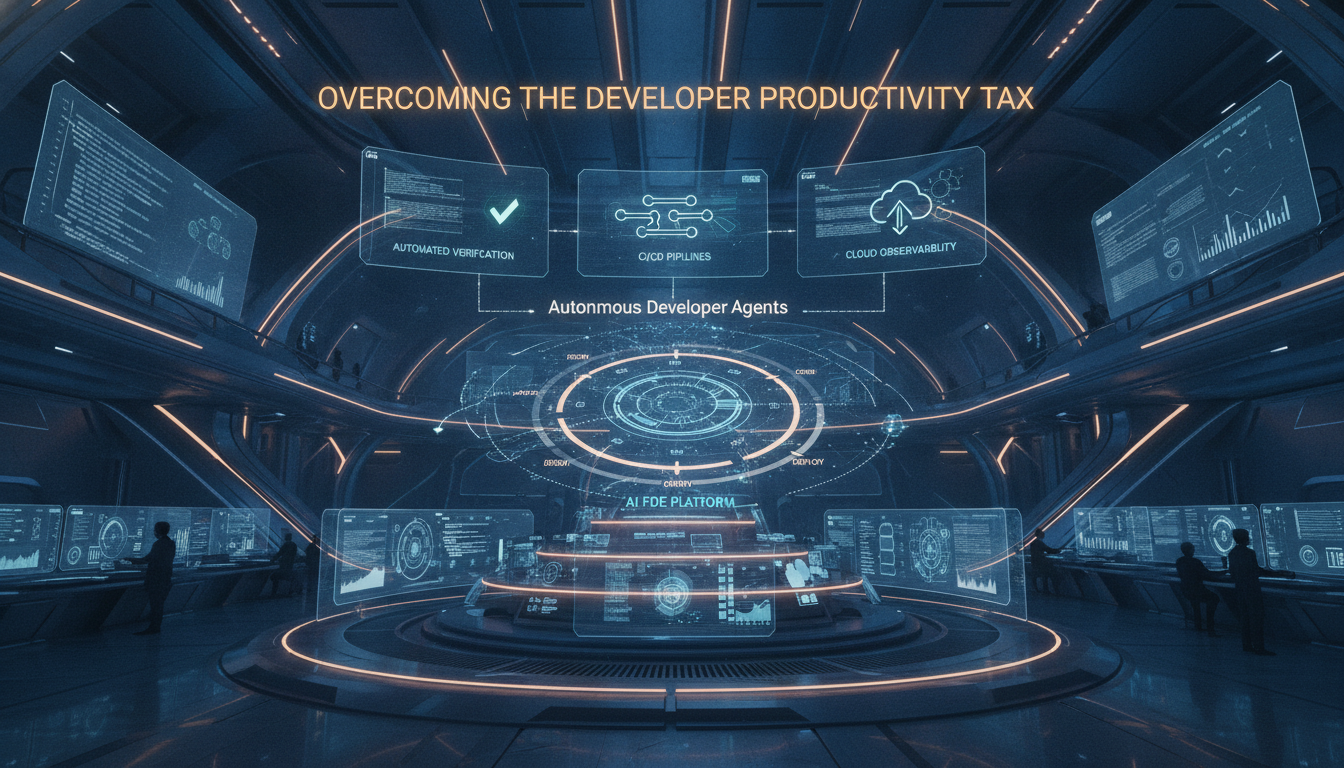
As of September 2026, global Google Trends and developer community analytics (Hacker News, Reddit r/devops, and engineering benchmarks) reveal a pivotal paradigm shift.
Search volumes for basic generative AI terms like "AI coding assistant" and "code autocomplete" have noticeably plateaued. In their place, queries for "Productivity Tax", "Agentic SDLC", "AI Orchestration Platform", and "Forward Deployed Engineer (FDE)" have skyrocketed by over 300% year-over-year.
Why are engineering organizations—equipped with the fastest code-generation tools in history—suddenly grappling with a self-proclaimed "Productivity Tax"?
This article examines the empirical data behind this trend, analyzes the structural limitations of standalone AI coding tools, and explores why an End-to-End AI FDE Platform like GIIP FDE Box has become the essential architectural foundation for modern enterprise software delivery.
1. The Anomaly in Search Data: What is the 'Productivity Tax'?
Recent 2026 software engineering benchmarks (such as empirical studies from METR and enterprise DevOps audits) have surfaced a startling reality:
"While initial Pull Request (PR) drafting time dropped by 58%, the total lead time required to ship reliable code to production either stagnated or increased."
Even more critically, research indicates that experienced senior developers working on complex distributed systems can actually be 19% slower when using standalone AI assistants. This is the Productivity Tax of the AI era.
This hidden tax stems from three primary sources:
- Rework and Verification Debt: AI excels at generating "almost right" code. However, diagnosing subtle edge-case omissions, unoptimized database queries, and architectural mismatches often takes more cognitive effort than writing clean code from scratch.
- Downstream Review Congestion: As pull requests flood in, senior code reviewers become overwhelmed. Unvetted "AI slop" clogs review queues, creating multi-day bottlenecks before merges can occur.
- Tool Sprawl & Cognitive Context-Switching: Juggling between IDE plugins, terminal CLIs, cloud consoles, and issue trackers breaks developer flow and introduces coordination friction.
2. 'Code Generation' vs. 'Software Engineering': The Critical Divide
The fundamental mistake many organizations make is conflating coding with software engineering.
Standalone tools like Cursor, Claude Code, or Codex are fantastic individual code writers. But writing code is only a fraction of the enterprise software lifecycle.
| Dimension | Standalone AI Coding Agent | Enterprise Production Requirement |
|---|---|---|
| Scope | File-level edits within an IDE editor | End-to-end from specs to production telemetry |
| Autonomy | Requires constant human prompting & intervention | Multi-agent autonomous collaboration & orchestration |
| Data & Infra | Unaware of real-time schema & cloud topology | Zero-downtime migrations & strict schema governance |
| Verification | Basic unit test scaffolding | Evidence-first regression testing & Zero-Script QA |
| Operations | Completely absent | 24/7 observability, Root Cause Analysis (RCA), self-healing |
A standalone assistant accelerates typing, but it leaves downstream engineering problems completely unaddressed. This is why late-2026 industry demand has shifted toward the concept of the Forward Deployed Engineer (FDE)—engineers and systems capable of owning the entire delivery pipeline in the field.
3. The Architecture: How GIIP FDE Box Eliminates the Productivity Tax
GIIP (GIIP FDE Box) was purpose-built to solve the Productivity Tax by functioning not merely as another coding tool, but as a comprehensive AI FDE Orchestration Platform.
GIIP orchestrates an entire team of specialized autonomous agents to deliver enterprise software with full governance and zero guesswork:
[ Business Requirements / Tickets ]
                 │
                 ▼
┌────────────────────────────────────────────────────────┐
│               GIIP FDE Box Orchestrator                │
├───────────────┬────────────────────────┬───────────────┤
│  1. Architecture│ 2. Multi-Agent Team   │  3. Verification │
│  · Strict DDL  │ · Planner + Coder     │ · Zero-Script QA│
│  · No Schema   │ · Reviewer + Tester   │ · Evidence-First│
│    Drift       │                       │   Guards        │
├───────────────┴────────────────────────┴───────────────┤
│  4. Autonomous DevOps & Production SRE                 │
│  · Automated CI/CD Deployments · Cloud Cost Management │
│  · Real-Time Telemetry & Observability · Self-Healing  │
└────────────────────────────────────────────────────────┘
                 │
                 ▼
[ Resilient Production Software Delivered with High Confidence ]
Key Architectural Merits of GIIP FDE Box
- End-to-End SDLC Orchestration: From issue intake to architecture planning, schema verification, multi-agent coding, automated testing, CI/CD pipeline triggers, and live monitoring, GIIP executes within a single closed-loop platform.
- Strict Guardrails That Eliminate Rework:
GIIP enforces battle-tested operational rules:
- NO RAW SQL Rule: Prohibits arbitrary SQL calls and mandates schema verification before query generation.
- Evidence-First Doctrine: Requires empirical logs and execution traces linked directly to every task.
- Resource Safety: Automatically detects runaway animation loops and enforces viewport-based observers to prevent client crashes.
- Multi-LLM Dynamic Routing: To combat soaring inference bills, GIIP routes tasks dynamically: fast, lightweight models (e.g., Gemini Flash) for deterministic tasks, and deep reasoning models (e.g., Gemini Pro, Claude) for complex architectural planning.
- Autonomous Production SRE & Self-Healing: GIIP monitors live production metrics and error logs around the clock. When anomalies arise, it analyzes the root cause and generates self-healing patches before users notice.
4. Proven by Real-World Dogfooding: The GIIP Benchmark
Unlike theoretical platforms, GIIP FDE Box has been proven through extensive internal dogfooding:
- 30,000+ Production Source Files: The entire codebase powering the GIIP ecosystem was constructed from zero and is continuously maintained on GIIP FDE Box.
- Full Cloud Infrastructure Under FDE Management: Azure serverless functions, managed SQL databases, caching tiers, and GitHub Actions pipelines run under the direct stewardship of GIIP agents.
- Measurable Defect Reduction: By enforcing strict validation before merge, GIIP eliminates the verification drag that plagues traditional AI coding setups.
5. Conclusion: From Copilots to Paved-Road Platforms
The message from 2026 Google Trends is unambiguous:
"Adding more individual AI coding tools does not accelerate software delivery. The true moat is an orchestration platform that manages the entire lifecycle with strict engineering guardrails."
The copilot era was step one. The future belongs to Platform Engineering powered by AI FDE Platforms. For enterprises looking to eliminate the Productivity Tax and achieve true engineering velocity, GIIP FDE Box provides the proven, production-grade foundation.


Comments
Post a Comment