[Google Trends 2026] Beyond MCP to the A2A (Agent-to-Agent) Era: Preventing Multi-Agent Cascade Failures with the Enterprise AI FDE Platform 'GIIP'
[Google Trends 2026] Beyond MCP to the A2A (Agent-to-Agent) Era: Preventing Multi-Agent Cascade Failures with the Enterprise AI FDE Platform 'GIIP'
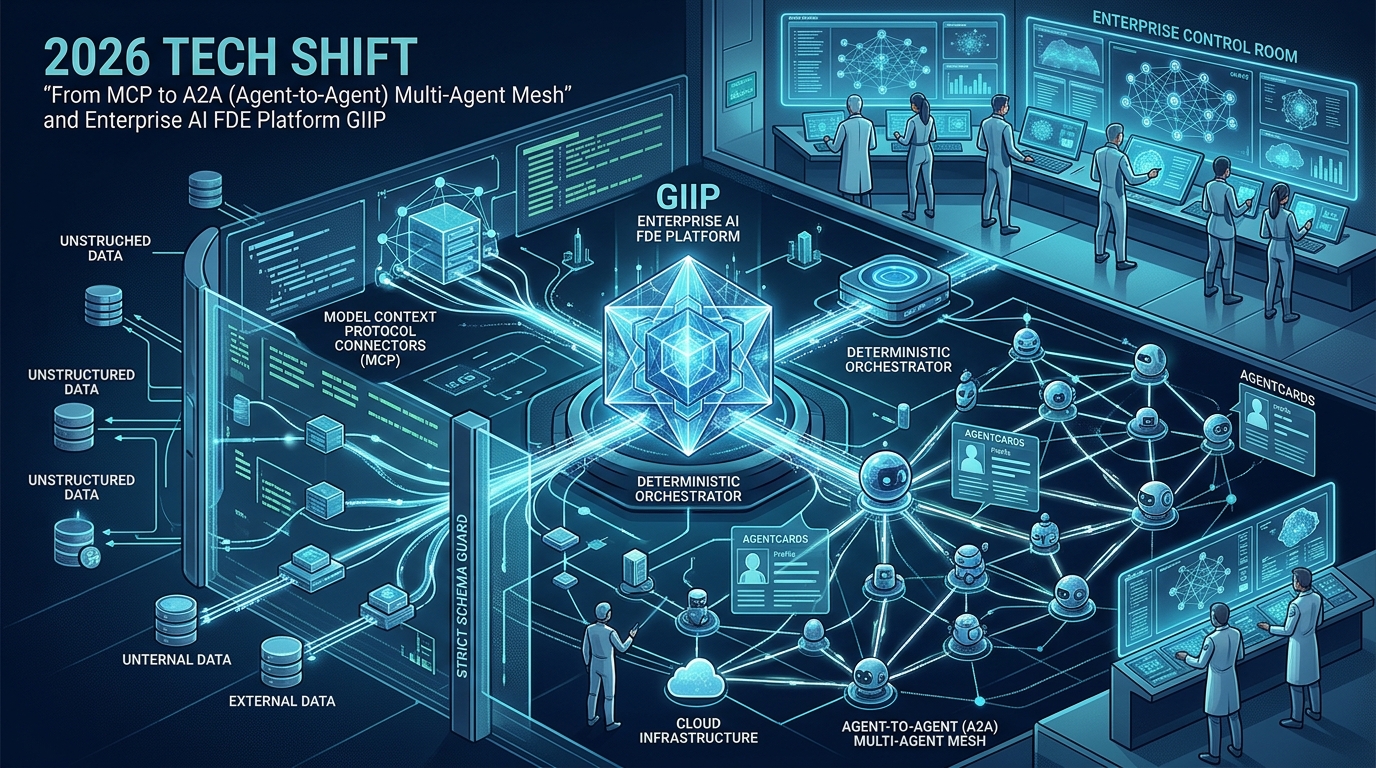
Overview: The Major Paradigm Shift Signaled by Autumn 2026 Google Trends
In autumn 2026, real-time search intelligence from Google Trends captures an unmistakable inflection point across global software engineering.
While search volume for "single-agent coding assistants" and "prompt engineering tricks" has leveled off and begun to decline, queries for "Agent-to-Agent Protocol (A2A)", "A2A vs MCP", "AgentCards", "Multi-Agent Cascading Failure", and "AI FDE Platform (Forward Deployed Engineer Platform)" have surged by a staggering 680%+ year-over-year.
This tectonic realignment reflects the harsh reality facing enterprise technology leaders today.
If 2025 was the era of MCP (Model Context Protocol: the "USB-C of AI"), standardizing how an individual AI model connects to external tools, databases, and APIs, 2026 marks the dawn of the A2A (Agent-to-Agent Protocol: the "HTTP of AI") era—where autonomous, specialized agents discover, negotiate, and delegate complex end-to-end tasks to one another across distributed networks.
With the Linux Foundation's Agentic AI Foundation (AAIF) ratifying both Anthropic's MCP and Google's A2A as complementary dual standards, enterprise software delivery has evolved from "prompting a monolithic AI" into a decentralized Multi-Agent Mesh comprised of specialized worker agents.
However, as agents began chatting and handing off artifacts autonomously, engineering teams collided head-on with a catastrophic new bottleneck: the Multi-Agent Cascading Crisis.
In this article, we dissect the architectural mechanics of MCP and A2A, expose the existential risks of uncontrolled multi-agent interaction, and examine how GIIP (GIIP FDE Box + FDE Ops)—a next-generation AI Forward Deployed Engineer Platform—delivers deterministic governance and 24/7 Day-2 autonomous SRE to guarantee enterprise-grade production reliability.
1. The 2026 Enterprise AI Protocol Stack: MCP vs. A2A Deep Dive
As industry consensus affirms: "If MCP is the USB-C of AI, A2A is the HTTP of AI." Rather than competing, they represent two vital halves of the production-ready autonomous stack.
┌────────────────────────────────────────────────────────────────────────┐
│                        A2A (Agent-to-Agent Layer)                      │
│   - Spearheaded by Google / Standardized under Linux Foundation        │
│   - Dynamic discovery of peer agents via AgentCards (/.well-known/...) │
│   - Cross-framework task delegation, contract negotiation, agent mesh  │
└───────────────────────────────────┬────────────────────────────────────┘
                                    │ Task Delegation
                                    ▼
┌────────────────────────────────────────────────────────────────────────┐
│                     MCP (Model Context Protocol Layer)                 │
│   - Spearheaded by Anthropic / Standardized under Linux Foundation     │
│   - Model-to-Tool / Database / Filesystem connectivity                 │
│   - Standardized I/O pipelines and secure context ingestion            │
└───────────────────────────────────┬────────────────────────────────────┘
                                    │ Resource Execution
                                    ▼
                 [ Legacy Databases / Cloud Infrastructure / APIs ]
Architectural Comparison: MCP vs. A2A
| Feature / Dimension | MCP (Model Context Protocol) | A2A (Agent-to-Agent Protocol) |
|---|---|---|
| Core Role | Model-to-Tool / Data (Extending an agent's senses & tools) | Agent-to-Agent (Inter-agent collaboration & delegation) |
| Industry Metaphor | AI's USB-C Connector | AI's HTTP Web Protocol |
| Discovery Mechanism | MCP Server tools/list and resources/list |
/.well-known/agent.json with AgentCards metadata |
| Communication Pattern | JSON-RPC 2.0 Client-Server Request/Response | Asynchronous message exchange, Long-running Task channels |
| Security & Auth | Token authorization, process-level sandbox | DPoP (Proof of Possession), Workload Identity Federation |
| Primary Use Case | "Agent queries PostgreSQL table and edits local source file" | "Planning Agent delegates OpenAPI implementation to Backend Agent" |
While over 95% of enterprise AI architectures in 2026 build upon this dual stack, protocol compliance alone does not prevent software disaster. When unconstrained agents interact over networks, failures propagate with unprecedented velocity.
2. Production Alert: Anatomy of the Multi-Agent Cascading Crisis
As autonomous agents begin executing tasks handed down by peer agents, more than 70% of enterprise pilot projects experience severe system gridlocks or data corruption.
3 Fatal Vulnerabilities in Unconstrained Multi-Agent Meshes
Cascading Hallucination Amplification:
- In a single-model setup, a human can spot a hallucinated assumption immediately. In an A2A mesh, a 1% specification drift introduced by a Planning Agent is accepted as truth by the Backend Agent, which converts it into erroneous DDL, passed along to the Schema Agent. By the time it reaches the deployment stage, the error has metastasized into system-wide failure.
Deadlocks and Catastrophic Token Thrashing:
- When a Backend Agent and a QA Agent disagree over an API schema interpretation, they enter an infinite rebuttal loop. Lacking a deterministic arbiter, an unsupervised agent mesh can exhaust an entire month's API budget in a single night without producing a single working line of code.
Unbounded Database & Infrastructure Destruction:
- When a Database Agent armed with MCP database credentials blindly trusts an A2A migration task sent by a peer, it may issue unindexed table locks or destructive
ALTERcommands. Without comprehensive awareness of foreign key constraints or transaction isolation levels, one rogue query can freeze customer-facing transaction pipelines.
- When a Database Agent armed with MCP database credentials blindly trusts an A2A migration task sent by a peer, it may issue unindexed table locks or destructive
"Protocols pave the digital roads, but they provide neither seatbelts nor traffic signals."
This reality explains why engineering leaders are aggressively transitioning from raw agent frameworks toward an AI FDE Platform (GIIP).
3. The Definitive Solution: Deterministic Orchestration via GIIP (AI FDE Platform)
Originating at Palantir, the Forward Deployed Engineer (FDE) is an elite software engineer embedded directly inside customer environments to integrate bleeding-edge technology with mission-critical legacy infrastructure.
GIIP (GIIP FDE Box + FDE Ops) represents the enterprise automation of this doctrine. GIIP embraces the open MCP and A2A standards while enforcing a deterministic governance harness and 24/7 Day-2 autonomous SRE to guarantee flawless production delivery.
flowchart TD
    subgraph ClientLayer["1. Specification & Intent Layer"]
        USER["Natural Language Intent / Business Goals"]
        INTENT["GIIP Intent Analyzer (SDD Structured Spec)"]
    end

    subgraph A2AMesh["2. A2A & MCP Deterministic Assembly Line"]
        CONDUCTOR["GIIP FDE Conductor (Deterministic DAG Router)"]
        AGENT_FE["Frontend Agent (worktree/ui)"]
        AGENT_BE["Backend Agent (worktree/api)"]
        AGENT_DB["Schema Agent (worktree/db)"]
    end

    subgraph Governance["3. GIIP Strict Boundary & Gateways"]
        CIRCUIT["Circuit Breaker (Loop prevention & Token budget)"]
        SCHEMA_GUARD["Strict Schema Guardian (No Raw SQL / Verified Catalog)"]
        DUAL_KEY{"Dual-Key Write-Access Gate (Cryptographic HITL)"}
    end

    subgraph Production["4. Enterprise Production & Day-2 SRE"]
        SANDBOX["Ephemeral Cloud Sandbox (Dev/Stg Isolation)"]
        LIVE_VERIFY["Zero-Script QA (Live URL Endpoint Verification)"]
        SRE_OPS["GIIP FDE Ops (24/7 Day-2 Self-Healing & FinOps)"]
    end

    USER --> INTENT
    INTENT --> CONDUCTOR
    CONDUCTOR --> AGENT_FE & AGENT_BE & AGENT_DB
    AGENT_FE & AGENT_BE & AGENT_DB --> CIRCUIT
    CIRCUIT --> SCHEMA_GUARD
    SCHEMA_GUARD --> DUAL_KEY
    DUAL_KEY -->|Approved| SANDBOX
    SANDBOX --> LIVE_VERIFY
    LIVE_VERIFY --> SRE_OPS
    SRE_OPS -.->|Telemetry Feedback| CONDUCTOR
5 Core Architectural Advantages of GIIP FDE Box
1) Strict Schema Guardian ("No Speculation" Policy)
- Eradicates database hallucinations at the root.
- GIIP's golden rule: NO RAW SQL. All database access must route through verified schema catalogs and standardized management tools (
execSQLFile.ps1). If an agent attempts to guess a column name or execute unverified DDL, the pipeline instantly aborts the transaction.
2) Deterministic DAG Orchestration with Circuit Breakers
- Replaces chaotic free-form agent conversations with a structured Directed Acyclic Graph (DAG) workflow.
- If inter-agent rebuttals or token expenditures exceed predefined safety thresholds, the Circuit Breaker triggers immediately, halting the cascade and alerting the engineering team before budgets are drained.
3) Git Worktree & Ephemeral Cloud Sandbox Isolation
- To prevent file overwrites when multiple agents code simultaneously, each agent operates within a dedicated
git worktreeand an isolated ephemeral container. Failures are contained with zero blast radius to the host system.
4) Dual-Key Write-Access Governance & Zero-Script QA
- Unrestricted read/analysis, gated write/deployment: Destructive actions—such as schema migrations, IAM permission edits, or production domain routing—require both an automated impact report and explicit cryptographic human sign-off (HITL).
- Instead of brittle test scripts, GIIP applies Zero-Script QA, firing live telemetry queries against actual staging URLs to validate structured JSON logs and database state transitions end-to-end.
5) Day-2 Autonomous SRE Validated on 180 Billion JPY Operations
- Code delivery is merely day one. GIIP FDE Ops runs continuous 24/7 health probing, detects query deadlocks, and performs automated self-healing rollbacks guided by AI runbooks.
- GIIP's operational core is battle-hardened, having powered mission-critical enterprise systems managing over 180 billion JPY in annual transaction volume with flawless availability.
4. Competitive Engineering Comparison Matrix
| Architectural Dimension | Generic Chat AI (ChatGPT, etc.) | Single Coding Tool (Cursor, etc.) | Open Source Frameworks (CrewAI, etc.) | GIIP AI FDE Platform (GIIP FDE Box) |
|---|---|---|---|---|
| Agent Topology | Single model dialogue | Single agent IDE assistant | Unstructured multi-agent chatter | A2A/MCP Deterministic Assembly Line (DAG) |
| Workspace Isolation | None | Single local workspace | Basic process separation | Git Worktree + Ephemeral Containers |
| Schema Integrity | Frequent hallucinations | Manual human review | No built-in safeguard | Strict Schema Guardian (No Raw SQL enforced) |
| Infinite Loop Defense | Timeout-based | Manual stop required | Frequent token thrashing | Integrated Circuit Breaker & Token Budgets |
| Production Gateways | None | Prompt confirmation | None | Dual-Key Write Governance (Cryptographic HITL) |
| QA Verification | Code suggestions only | Unit test generation | Assertion tampering risks | Zero-Script QA (Live URL telemetry testing) |
| Day-2 SRE Operations | Unsupported | Unsupported | Unsupported | 24/7 Autonomous SRE (180B JPY track record) |
5. Three Practical Directives for Engineering Leaders
1) "Do Not Rely on Raw Protocols—Deploy a Deterministic Arbiter"
Protocol compatibility (A2A) enables communication, not correctness. Insert deterministic DAG orchestration, budget limits, and circuit breakers into your agent communication mesh.
2) "Enforce Zero-Tolerance Across Databases and Infrastructure"
Allow generative agents full autonomy in prototyping logic, but enforce Strict Schema verification and Dual-Key electronic approval for all database modifications and IAM permission alterations.
3) "Adopt an End-to-End AI FDE Platform"
Fractured toolchains create exponential cognitive friction. Consolidate your delivery pipeline under GIIP FDE Box to upgrade your engineering organization into an elite Forward Deployed Engineering force.
Conclusion: From Interconnected Agents to Production Mastery
As Google Trends reveals, generative software development has outgrown the era of raw benchmark scores. The decisive battlefield is how seamlessly distributed agent swarms collaborate to solve real enterprise problems under strict operational discipline.
Armed with MCP tools and connected via A2A, autonomous agents need a battle-tested harness to reach their true potential.
GIIP (AI FDE Platform) bridges the perilous gap between agent communication and enterprise production excellence. Take the next step with GIIP and master the frontier of agentic engineering today.
Next Steps with GIIP (AI FDE Platform)
Explore tailored roadmaps designed for your organizational role:
- 🏢 For Executives & Decision Makers: Business Value & TCO Reduction Roadmap
- 💻 For Engineers & System Architects: Deep Architectural Verification & FDE Pipeline
- 🤝 For Global Partners & Solution Providers: AI FDE Partnership Inquiries


Comments
Post a Comment